How DSC Supports Polymer Product Development and Quality Control
Introduction
Differential scanning calorimetry (DSC) is a laboratory technique that tracks how much heat a sample takes in or gives off while it is warmed, cooled or held at a fixed temperature. The sample is always compared with an inert reference. DSC is among the most common ways to characterize polymers, and only a few milligrams of material are needed to reveal melting, crystallization, the glass transition and curing reactions [13].
The ISO 11357 series sets out DSC methods for thermoplastics (plastics that soften when heated), thermosets (plastics that harden through curing) and elastomers (rubber like materials), whether or not they contain fillers, fibers or reinforcements [1]. It deals with physical changes (glass transition, melting, crystallization and changes between crystal forms), chemical reactions (polymerization, crosslinking and curing), oxidation stability and heat capacity [1].
This article explains what DSC measures, how the results help with product development and quality control (QC), which standards apply and what affects the quality of the data. It also shows how to choose a method for the question you need to answer.
Understanding Differential Scanning Calorimetry
How the measurement works
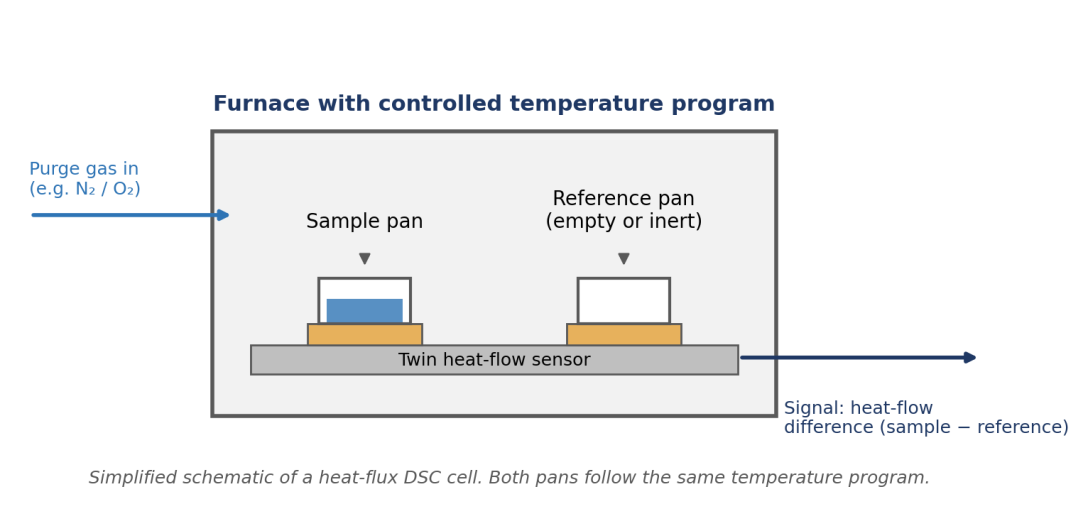
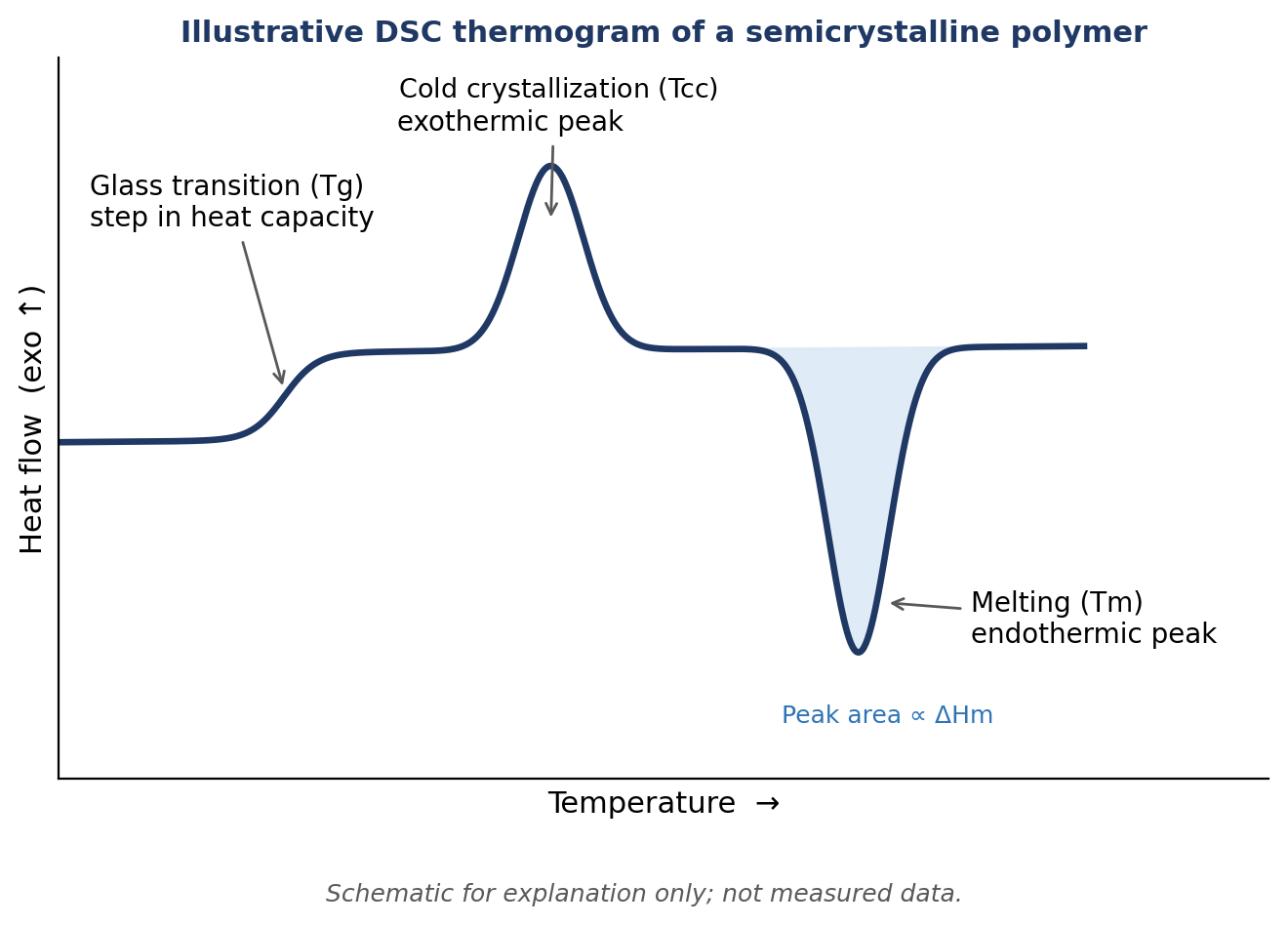
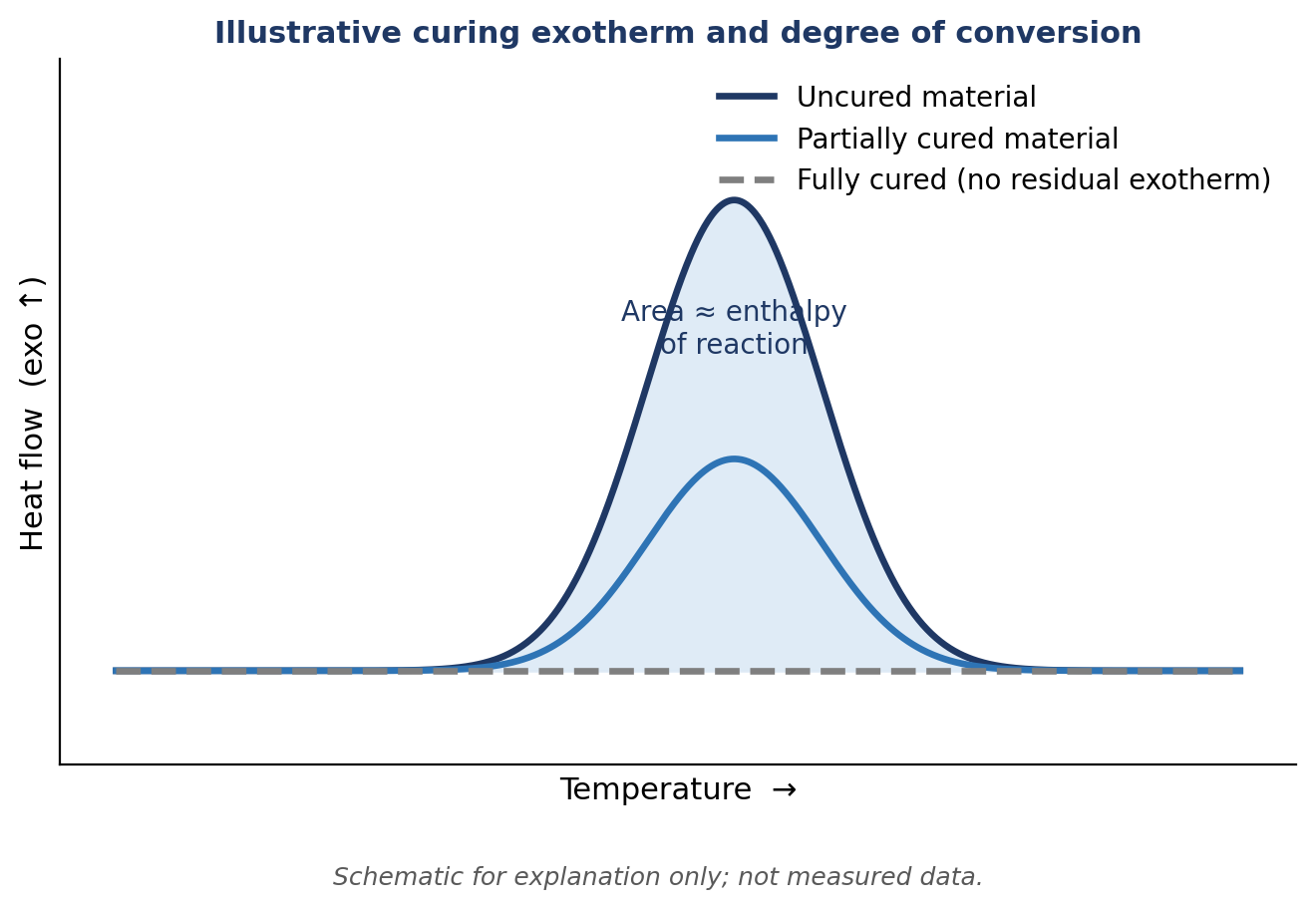
A DSC heats or cools a sample and an inert reference according to a controlled temperature program. It records the difference in heat flow between the two over time and temperature [11]. When the sample absorbs heat (an endothermic event) or releases heat (an exothermic event), the signal moves away from its baseline. In the figures in this article, exothermic events point upward. Some instruments and publications plot them the other way, so always check the axis label. The area under a peak relates to the energy of the process, known as its enthalpy, and the position of the peak shows the temperature at which the process happens.
Two basic instrument designs exist: heat flux DSC and power compensation DSC [12]. DSC is sometimes confused with differential thermal analysis (DTA). DTA reports only the temperature difference between sample and reference, whereas DSC measures heat flow [14].
What a polymer thermogram shows
- Glass transition (Tg). The glass transition appears as a step in the curve, not a peak, because the heat capacity of the material changes [8][15]. Above Tg, a polymer has a higher heat capacity than below it, and Tg is usually read from the middle of the step [15].
- Melting. Melting absorbs heat. It gives the melting temperature (Tm) and the enthalpy of fusion (ΔHm), which is the energy absorbed during melting, in J/g [16].
- Crystallization. Crystallization releases heat and appears as an exothermic peak that gives the crystallization temperature (Tc) and its enthalpy (ΔHc) [16]. Above Tg, polymer chains can move enough to arrange themselves into crystals, which is why "cold crystallization" can appear during heating [15]. It is often labeled Tcc to separate it from crystallization on cooling (Tc).
- Chemical reactions. Oxidation, curing of thermosetting resins and thermal decomposition can also produce DSC signals [7].
Why DSC Matters for Polymer Manufacturers and Laboratories
The significance statements in the relevant ASTM methods describe the practical value clearly:
- ASTM D3418 states that DSC helps identify specific polymers, polymer blends (alloys) and certain additives that show thermal transitions. It also describes the method as useful for specification acceptance, process control and research [7].
- ASTM E1356 notes that Tg can reveal a material's thermal history, processing conditions, stability, the progress of chemical reactions, and mechanical and electrical behavior. It describes the method as useful for research, quality control and specification acceptance [8].
DSC can also determine heat capacity, heat of transition, kinetic data, purity and degree of crystallinity, all from milligram quantities [13]. Its real strength is that a single experiment delivers several linked pieces of information.
Key DSC Parameters for Polymers
| Test parameter | What it measures | Why it matters |
|---|---|---|
| Glass transition temperature (Tg) | Step change in heat capacity of the amorphous (non crystalline) part of the polymer [8] | Reflects thermal history and processing. Used in research, QC and acceptance [8] |
| Melting temperature (Tm) and enthalpy of fusion (ΔHm) | Heat absorbed as crystalline regions melt [16] | Helps identify polymers and compare materials [7][16] |
| Crystallization temperature (Tc) and enthalpy (ΔHc) | Heat released as crystals form on cooling or heating [16] | Shows crystallization behavior that matters for processing [7] |
| Specific heat capacity | Heat needed per unit mass per degree | Standardized for plastics in ISO 11357-4 [2] |
| Reaction temperatures, enthalpy of reaction, degree of conversion | Curing and other reactions [2][5] | Tracks cure progress of thermosets and elastomers [1][7] |
| Oxidation induction time (OIT) | How well a stabilized material resists oxidation [3][9] | Gives a qualitative view of the stabilization level [9] |
Degree of crystallinity
The degree of crystallinity can be worked out from DSC data [13], but the assumptions behind it need care. ASTM D3418 warns that true heats of fusion should be established together with structural investigation, and that specialized crystallization techniques are often needed [6]. Crystallinity taken from a single melting peak is therefore an estimate, not a definitive structural measurement.
Standards and Test Methods
Most polymer DSC work follows ISO 11357 or an ASTM method. ISO 11357-1 covers the principle, apparatus, sampling, calibration and reporting that are common to every part of the series. The other parts give the details for specific methods [1].
| Standard | Subject | Application |
|---|---|---|
| ISO 11357-1 | General principles, apparatus, sampling, calibration and test report [1] | Foundation for all parts |
| ISO 11357-2 | Glass transition temperature and step height [2] | Amorphous and semicrystalline plastics |
| ISO 11357-3 | Temperature and enthalpy of melting and crystallization of crystalline or partially crystalline plastics [2] | Crystallinity and processing behavior |
| ISO 11357-4 | Specific heat capacity [2] | Thermal property data |
| ISO 11357-5 | Reaction temperatures and times, enthalpy of reaction and degree of conversion for monomers, prepolymers and polymers [2] | Curing and conversion |
| ISO 11357-6 | Oxidation induction time (isothermal) and oxidation induction temperature (dynamic) [3] | Stabilization of polyolefins [3] |
| ASTM D3418 | Transition temperatures and enthalpies of fusion and crystallization of polymers [6] | Polymers as granules or fabricated shapes [6] |
| ASTM E1356 | Assignment of glass transition temperatures by DSC or DTA [8] | Amorphous materials, or partially crystalline materials with amorphous regions [8] |
| ASTM D3895 | Oxidative induction time of polyolefins [9] | Fully stabilized or compounded polyolefin resins [9] |
Some parts are also published as EN ISO adoptions, so European laboratories may cite them in that form [1].
Scope details that affect method choice
- ASTM D3418 gives a normal operating range from the cryogenic region up to 600 °C, which can be extended with suitable equipment. It also notes that the method as written does not suit every type of polymer [6].
- ASTM E1356 gives a normal range of minus 120 °C to 500 °C, which can be extended depending on the instrument. It applies only to materials that do not decompose or sublimate in the glass transition region [8].
- ISO 11357-6 applies to polyolefin resins in fully stabilized or compounded form, either as raw materials or finished products. It may also apply to other plastics [3][4].
Check the edition status
Editions change, and several parts of ISO 11357 were revised recently:
- ISO 11357-1:2023 replaced the 2016 edition [1].
- ISO 11357-3:2025 replaced the 2018 edition, and ISO 11357-5:2025 replaced the 2013 edition. Both state that they apply to conventional DSC as specified in ISO 11357-1, not to fast DSC (ISO 23976) [2].
- ISO 11357-2:2020 was confirmed in 2025, and ISO 11357-4:2021 is listed as under periodic review [2].
- ISO 11357-6 has a 2025 edition [4], and the 2018 edition is shown as withdrawn in the EN listing [3].
- ISO 11357-7:2015 (crystallization kinetics) was withdrawn and replaced by ISO 11357-7:2022 [17].
- On the ASTM side, D3418-21, D3895-19 and E1356-25 are listed as the current editions [6][7][8][9], and the significance wording cited in this article matches those editions.
Confirm the current version with ISO, CEN, ASTM or your national standards body before writing it into a specification.
General DSC Testing Workflow
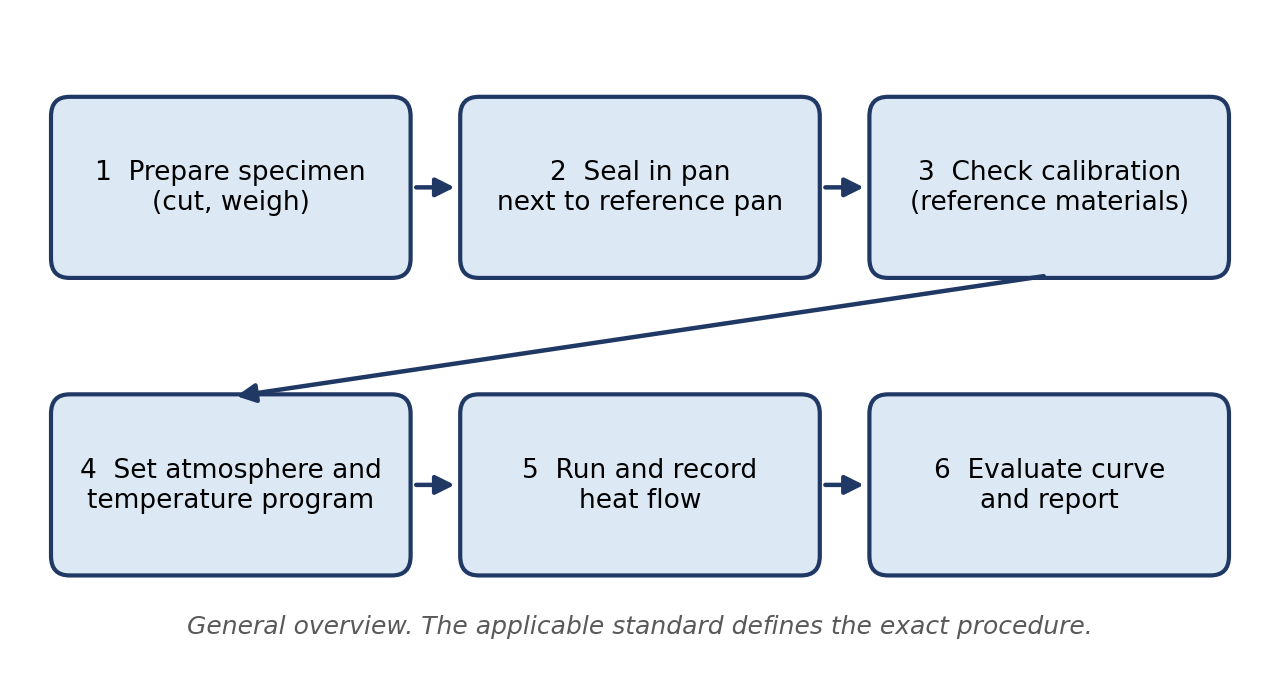
The standards define the exact procedure, so what follows is only an overview:
- Prepare the specimen. ASTM D3418 covers polymers as granules or as any fabricated shape from which a suitable specimen can be cut [6]. The specimen is weighed and sealed in a pan, with a reference pan alongside it.
- Check calibration. Confirm the temperature and heat flow response against reference materials (see the next section).
- Set the atmosphere and program. The purge gas, heating and cooling rates and temperature limits are set as the applicable standard specifies [1]. Many laboratory protocols use a heat, cool and reheat sequence. The first heating shows the thermal history of the sample, while the second heating shows how the material behaves after a controlled history. Always follow the program given in the applicable standard [6].
- Evaluate the curve. Read the Tg step, peak temperatures, enthalpies or OIT as the method defines them.
- Report. ISO 11357-1 sets out the general content of the test report [1].
Factors Affecting DSC Results
Calibration. One manufacturer's calibration guidance makes these points [10]:
- A reliable calibration needs a clean cell, a controlled inert purge gas, an accurate balance and high purity reference materials.
- Temperature calibration uses known reference standards, typically pure metals such as indium, tin and lead (ASTM E967).
- Changing the purge gas type means the baseline, temperature and cell constant (the correction factor for heat flow) should be calibrated again.
- Changing the pan type means the temperature and cell constant should be calibrated again.
- Reinstalling or changing a cooling accessory means a full recalibration.
Baseline behavior. A real heat flux DSC is never perfectly symmetrical, so the baseline usually has some slope and offset [11]. This can make weak transitions, especially glass transitions, harder to detect.
Thermal history and sample state. Tg reflects thermal history and processing [8], so two samples of the same polymer can show different values for that reason alone.
Decomposition or sublimation. ASTM E1356 applies only where the material does not decompose or sublimate (turn directly from solid to gas) in the glass transition region [8].
Additive volatility (OIT). ASTM D3895 warns that volatile antioxidants can give poor OIT results even when the product performs adequately at its intended use temperature [9].
Method applicability. Not every polymer suits ASTM D3418 as written [6].
Industry Applications
The ISO 11357 series covers thermoplastics, thermosets and elastomers, so DSC is relevant wherever these materials are made or used [1].
- Resin and compound suppliers use melting and crystallization data to identify polymers and check batches [7].
- Additives and stabilization. OIT tests based on DSC show whether polyolefin materials are adequately stabilized [3][9].
- Thermosets and elastomers. Curing and crosslinking reactions can be followed through reaction enthalpies and degree of conversion [1][2].
- Contamination checks. One testing laboratory describes using DSC melting points together with FTIR (infrared spectroscopy) to identify materials, and to find contamination in resins and plastic parts that FTIR alone may miss [16].
Quality Control and Product Development
Incoming inspection and specification acceptance
DSC is recognized for specification acceptance [7][8]. Typical checks compare Tg, Tm or ΔHm against a specification or a reference lot. A shift in melting behavior can point to a different polymer grade, a blend or contamination [7][16].
Process control
ASTM D3418 lists process control as one of its uses [7]. Because Tg and crystallization behavior reflect thermal history and processing conditions [8], comparing parts made under different settings can show whether the process changed the state of the polymer. DSC alone cannot explain why the change happened.
Stabilization and shelf life screening
OIT gives a qualitative view of how well polyolefins are stabilized [9]. ASTM D3895 says it can serve as a QC measure for formulated resin before extrusion [9]. The same standard adds two cautions:
- OIT is an accelerated thermal aging test and can be misleading [9].
- No definitive relationship has been established between the OIT values of field samples and unused samples, so using OIT to estimate life expectancy is uncertain and subjective [9].
Use OIT to compare stabilization levels, not to predict service life.
Research and development
DSC supports formulation and material comparison work through transition temperatures, crystallization behavior, heat capacity and reaction enthalpies [13]. Kinetic data, purity and degree of crystallinity can also be derived [13].
Common Testing Challenges
- Overlapping thermal events. Transitions that overlap can be hard to separate. One manufacturer notes that modulated temperature DSC, or TMA (thermomechanical analysis) and DMA (dynamic mechanical analysis) instruments, can help where standard DSC reaches its limits [14].
- Weak glass transitions. A small step in heat capacity can be hard to locate on a curved baseline [11].
- Reading too much into a single number. Crystallinity taken from ΔHm, and OIT used as a predictor of life, both need the caution described above [6][9].
- Comparing results between laboratories. Differences in calibration, pans, purge gas and evaluation method can shift results [10]. Report the standard, edition and test conditions with every result [1].
- Standards mismatch. Different methods have different scopes and temperature ranges [6][8], and editions change [1][4].
How to Select the Appropriate DSC Method
- Define the question. Identification and QC comparison point to melting and crystallization (ISO 11357-3, ASTM D3418) [2][6]. The softening behavior of amorphous regions points to Tg (ISO 11357-2, ASTM E1356) [2][8]. Cure state points to ISO 11357-5 [2]. Stabilization of polyolefins points to OIT (ISO 11357-6, ASTM D3895) [3][9].
- Check that the material fits. Confirm that the standard covers your polymer and its form [3][6][8][9].
- Check the temperature range. Compare the range of your instrument with the transitions of your material and the normal range of the standard [6][8].
- Consider a complementary technique. If DSC cannot separate overlapping effects, consider modulated temperature DSC, TMA or DMA [14].
- Plan calibration. Build calibration and recalibration into the procedure [10].
- Fix the edition. State the standard and its edition in the specification [1][4].
Conclusion
DSC turns a few milligrams of polymer into useful information about glass transition, melting, crystallization, curing and oxidation stability. These data support material identification, incoming inspection, process control and formulation work [7][8][13]. The ISO 11357 series and ASTM methods such as D3418, E1356 and D3895 define how each measurement is made and interpreted [1][2][6][8][9]. Reliable results depend on choosing a method that fits both the material and the question, on disciplined calibration [10], and on reading the results within the limits of each standard [6][9]. Because editions change, always confirm the current version before writing a standard into a specification [1][4].
Relevant Testshine Product
Bring Reliable Thermal Analysis to Your Polymer QC and Product Development Lab with the Testshine TS-DSC-100A Differential Scanning Calorimeter
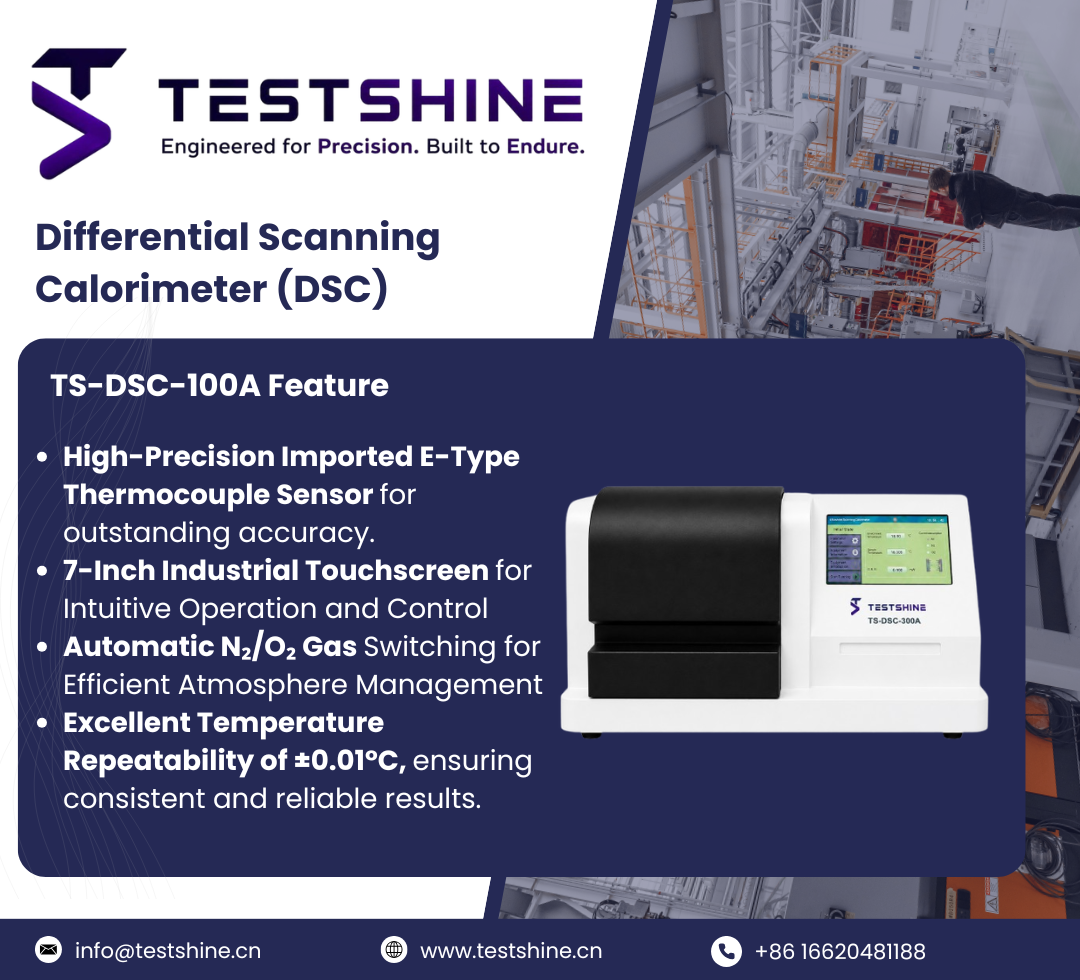
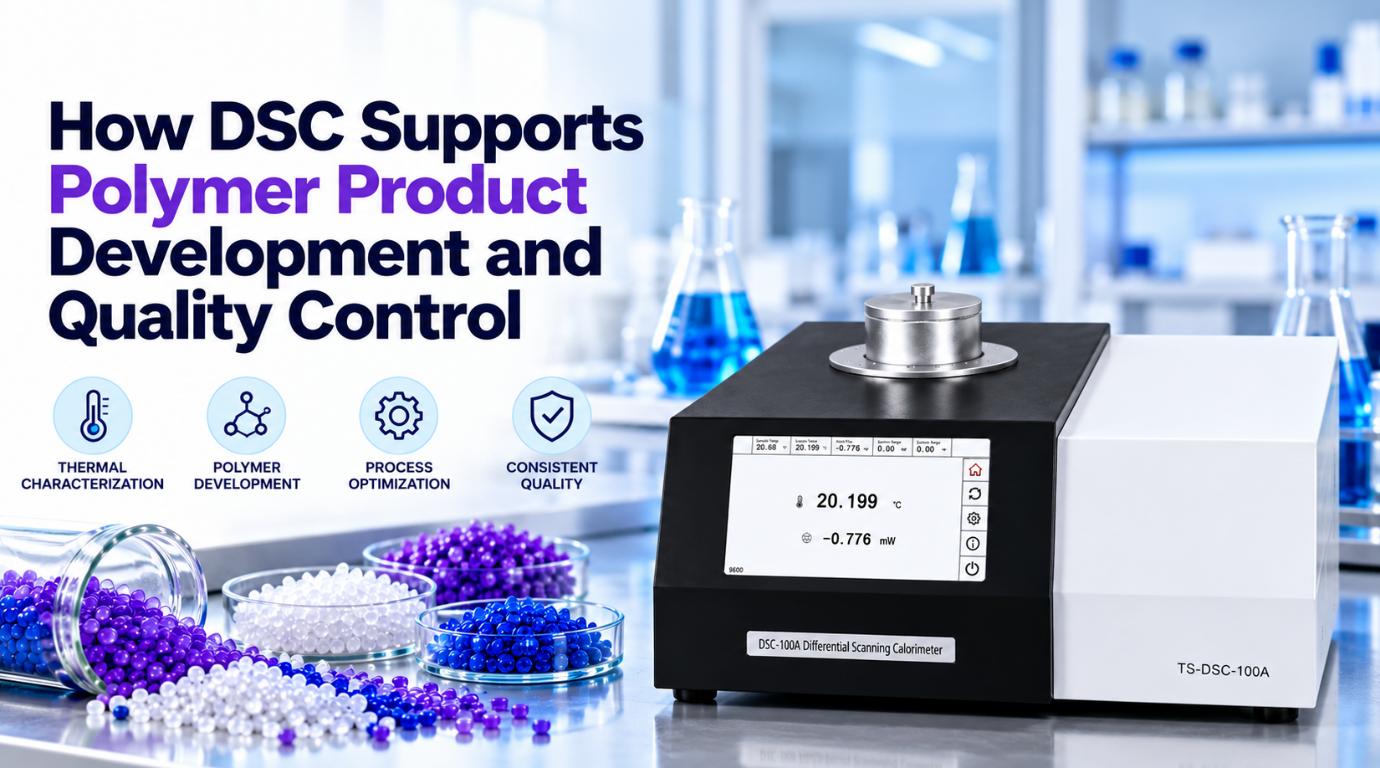
The changes and reactions discussed in this article, including glass transition, melting, curing and oxidation behavior, are all measured through heat flow. Reliable results therefore depend on a stable baseline and repeatable temperature control. The Testshine TS-DSC-100A Differential Scanning Calorimeter is a DSC instrument built for this kind of thermal analysis.
Why it fits the polymer testing workflow described above:
- Relevant test functions. According to Testshine, it can be used to test glass transition temperature, melting point, enthalpy value, curing temperature and oxidation induction period.
- Sensor and signal design. An imported E pair sensor and a shielded signal circuit, which Testshine describes as giving high sensitivity, good repeatability and stable baselines.
- Temperature control. Room temperature to 600 °C, with fully automatic program control of heating, constant temperature and cooling.
- Atmosphere control. Nitrogen and oxygen, with program setting and automatic switching.
- Operation and calibration. A 7 inch touch screen, a USB data interface, and indium and tin reference materials for temperature correction.
Testshine lists polymer and plastics, chemical, food and medical applications for the instrument.
References
-
ISO/CEN, "Plastics: Differential scanning calorimetry (DSC), Part 1: General principles," ISO 11357-1:2023 / EN ISO 11357-1:2023 (catalog entry, Estonian Centre for Standardisation and Accreditation). https://www.evs.ee/en/evs-en-iso-11357-1-2023
-
ISO, catalog pages for ISO 11357-2:2020 (confirmed 2025) https://www.iso.org/standard/77310.html, ISO 11357-3:2025 https://www.iso.org/standard/88106.html, ISO 11357-4:2021 https://www.iso.org/standard/79998.html and ISO 11357-5:2025 https://www.iso.org/standard/88107.html
-
Estonian Centre for Standardisation and Accreditation, "EVS-EN ISO 11357-6:2018, Determination of oxidation induction time (isothermal OIT) and oxidation induction temperature (dynamic OIT)," catalog entry with scope and status (2018 edition, now withdrawn). https://www.evs.ee/en/evs-en-iso-11357-6-2018
-
ISO, ISO 11357-6:2025, Fourth edition, June 2025: catalog page https://www.iso.org/standard/88108.html and preview pages (ANSI Webstore) https://webstore.ansi.org/preview-pages/ISO/preview_ISO+11357-6-2025.pdf
-
Estonian Centre for Standardisation and Accreditation, "EVS-EN ISO 11357-5:2014," catalog entry for the 2014 edition, which the 2025 edition of ISO 11357-5 has superseded. https://evs.ee/en/evs-en-iso11357-5-2014
-
ASTM International, "D3418-21, Standard Test Method for Transition Temperatures and Enthalpies of Fusion and Crystallization of Polymers by Differential Scanning Calorimetry" (scope text; listed as most recent), ANSI Webstore. https://webstore.ansi.org/standards/astm/astmd341821
-
ASTM International, "D3418-21" (significance and use, scope; active edition), ASTM Store. https://store.astm.org/d3418-21.html
-
ASTM International, "E1356-25, Standard Test Method for Assignment of the Glass Transition Temperatures by Differential Scanning Calorimetry" (scope, significance and use; active edition), ASTM Store. https://store.astm.org/e1356-25.html
-
ASTM International, "D3895-19, Standard Test Method for Oxidative Induction Time of Polyolefins by Differential Scanning Calorimetry" (scope, significance and use; active edition), ASTM Store. https://store.astm.org/d3895-19.html
-
TA Instruments, "Differential Scanning Calorimetry: Calorimetric and Temperature Calibration" (training slides, ©2018; copy hosted on the Duke Kunshan University website). https://dnas.dukekunshan.edu.cn/wp-content/uploads/2023/12/5.-Manual.pdf
-
TA Instruments, "Differential Scanning Calorimetry (DSC) Theory and Applications" (presentation). https://www.tainstruments.com/wp-content/uploads/DSC-Theory-Applications_PHL.pdf
-
G. W. H. Höhne, W. F. Hemminger and H. J. Flammersheim, Differential Scanning Calorimetry, 2nd ed., Springer, 2003. https://doi.org/10.1007/978-3-662-06710-9
-
G. W. H. Höhne, W. F. Hemminger and H. J. Flammersheim, Differential Scanning Calorimetry: An Introduction for Practitioners, Springer, 1996. https://rd.springer.com/book/10.1007/978-3-662-03302-9
-
Mettler Toledo, "Differential Scanning Calorimetry (DSC)" (technical FAQ on DSC vs DTA and limitations). https://www.mt.com/us/en/home/products/Laboratory_Analytics_Browse/TA_Family_Browse/DSC.html
-
Polymer Science Learning Center, "Differential Scanning Calorimetry." https://pslc.ws/macrog/dsc.htm
-
Intertek, "Heat of Fusion, Crystallization, Melting Point and Glass Transition by DSC: ASTM D3418, ASTM E1356, ISO 11357" (Testlopedia). https://www.intertek.com/polymersplastics/testlopedia/differential-scanning-calorimeter/
-
ISO, "ISO 11357-7:2022, Plastics: Differential scanning calorimetry (DSC), Part 7: Determination of crystallization kinetics" (catalog page; replaces the withdrawn 2015 edition). https://www.iso.org/standard/81832.html