
Heat Seal Strength Testing: Ensuring Reliable Seals in Flexible Packaging
Why Heat Seal Strength Testing Matters
A package is only as reliable as its seals. A pouch can have excellent barrier layers and sharp printing, yet still fail in transport if its seal opens too easily. A seal that needs too much force to open causes problems for users. Heat seal strength testing turns both concerns into numbers that can be compared and controlled.
Heat sealing joins two films using heat and pressure for a set time. As the joint cools, the layers bond together. The result depends on the plastic used, the film structure, the equipment and the settings. For this reason, laboratories look at how strength changes with temperature, sealing time and pressure, and they note how each test strip breaks [5][6].
This article explains how seals form, which settings matter, and how ASTM F88/F88M measures strength. It also covers hot seal strength, leak checking, test planning and the choice of laboratory equipment. It is written for packaging engineers, quality teams, laboratory staff, film developers and buyers. Statements based on standards or studies carry numbered references. Information about the Testshine TS-HS1 appears only in the product section at the end.
What Heat Seal Strength Measures
ASTM F88/F88M describes how to measure the strength of seals in flexible barrier materials. A narrow strip containing the seal is pulled apart. The force needed is recorded, together with a description of how the strip broke. The seal may join a flexible film to another flexible film, or to a rigid or partly rigid part. It may have been made in a laboratory or on a production line. A separate standard, ASTM F2824, covers pulling a whole lid off a round container [1]. At the time of writing, ASTM lists the 2023 edition of F88/F88M as current [1].
The standard describes seal strength as a number that helps prove a process works, shows whether it repeats, and keeps it under control. It relates to the force needed to open a package, to package integrity and to the ability of a process to make consistent seals [1]. A minimum strength is usually set so that the package stays closed. A maximum is mainly set for seals that the user is meant to peel open [1]. The strongest seal is therefore not always the best one.
The standard also gives two cautions. The recorded force reflects the way the seal is separated, and it can include stretching of the films. The test also covers only the strip that was tested. It does not copy the way a person opens a whole package [1].
How a Heat Seal Forms
The basic mechanism
In a heated bar sealer, two films are pressed between heated bars. Heat travels through the films to the surface where they touch. The sealing layer softens or melts, and the two layers bond. The seal reaches its full strength as it cools. Figure 1 shows the sequence in simple form.
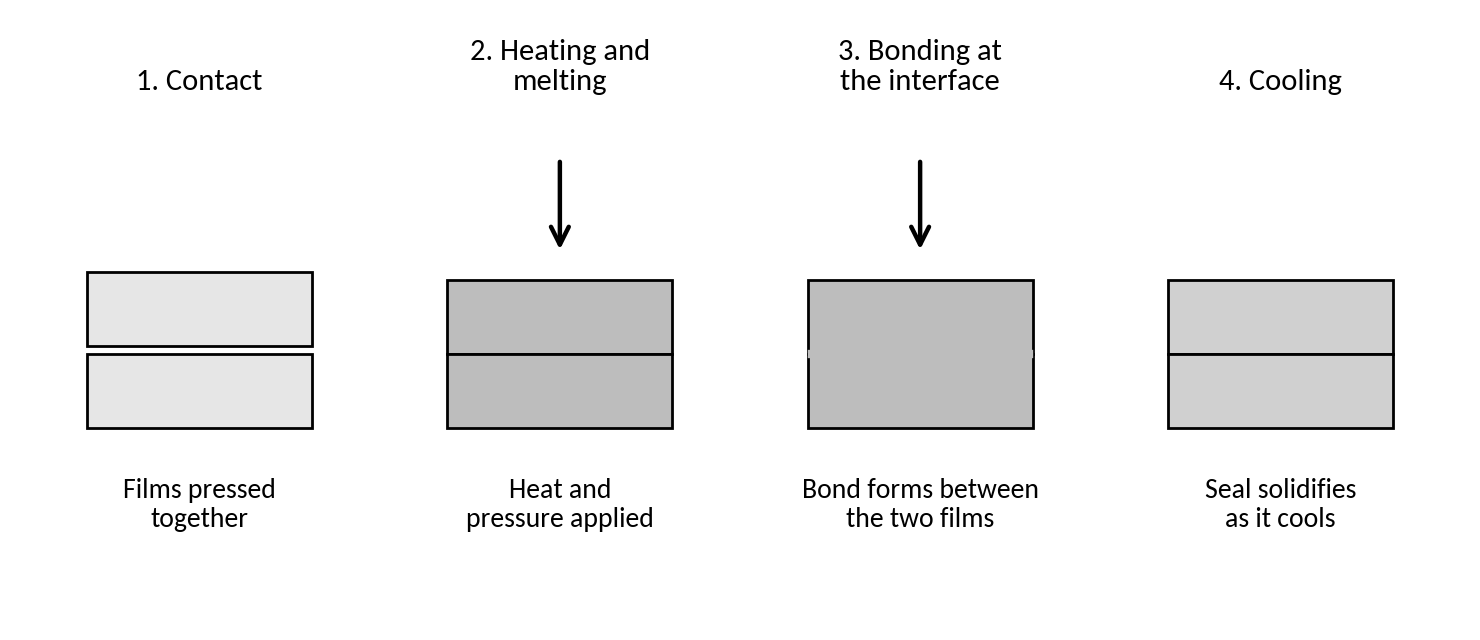
A study of a single layer polyethylene film found that the bond strength rose in proportion to how much of the film's crystalline structure had melted. How much melts depends on temperature and sealing time. Pressure mattered only until the two films were in close contact. Beyond that point, extra pressure gave no significant gain [5]. These results apply to that film. They should not be assumed for other materials without testing.
The sealing window
Seal strength does not keep rising as temperature increases. The same study described each set of conditions using five points: the temperature where sealing starts, the temperature where strength levels off, the final temperature of the level region, the strength in that region, and how the seal broke [5]. Figure 2 sketches this idea. It is a simple illustration of that description, and the shape will differ between materials.
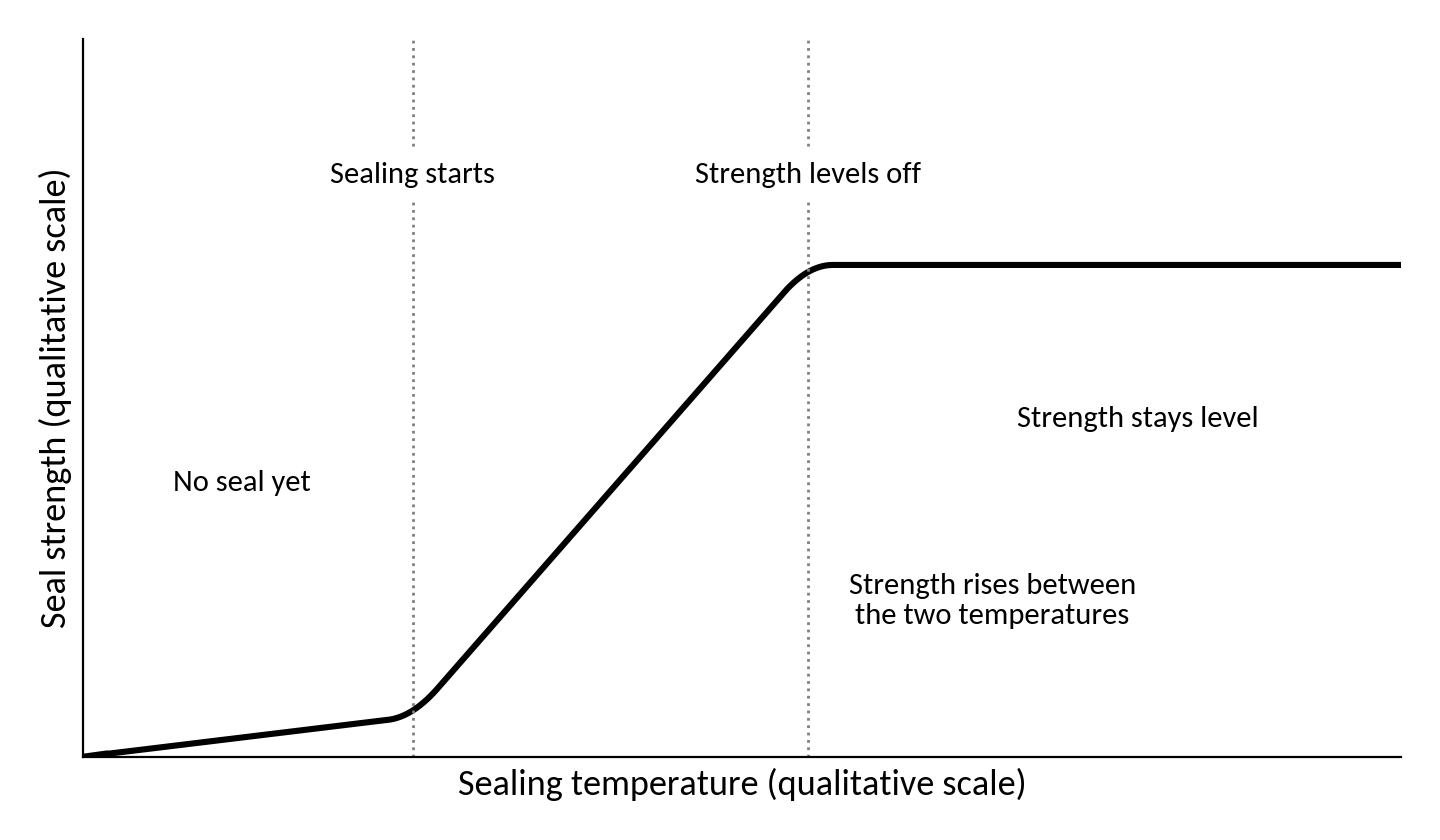
Work on laminated films with polyethylene sealing layers reached a similar conclusion. Each laminate has a best combination of bar temperature and sealing time, strength and the way the seal breaks are closely linked, and the sealing time needed follows how quickly heat travels through the film [6]. Because the window differs between materials, laboratories find it by testing rather than copying values from other films.
Materials Used in Heat Sealed Packaging
Heat sealing depends on a plastic layer that softens when heated. ASTM F2029 explains that seals may join the same material or different materials, and that each film may be a single material or a structure of several layers, such as coextruded, coated or laminated films. It also states that the overall structure and thickness of the film affect sealing, not only the sealing layer [2]. A single layer film can therefore behave very differently from a laminate.
The studies cited here focus on polyethylene: a single layer film [5] and laminates with polyethylene sealing layers [6]. They show how temperature, time and pressure work together, but they cannot replace testing of the film you actually use. When a film is sealed to a rigid part, the method of holding the sample should be agreed and reported. The standard also advises checking the effect of fixtures and of which material sits in which grip when a test method is set up [1].
Key Settings in Laboratory Heat Sealing
Table 1 lists the settings most often controlled when seals are made in the laboratory. The comments come from the cited sources and are not universal values.
| Setting | What it does | Evidence and cautions |
|---|---|---|
| Sealing temperature | Controls how far the sealing layer softens or melts. | Linked to how much of the polyethylene melts and to bond strength [5]. The best value depends on the material and structure [6]. |
| Sealing time | Gives heat time to reach the joint and the bond time to form. | Longer times raised strength in the polyethylene study, at different rates over different time ranges [5]. The time needed follows heat flow through the film [6]. |
| Sealing pressure | Brings the two films into close contact. | Important until close contact is reached, with little added benefit afterwards [5]. Other materials must be tested. |
| Film structure and thickness | Changes how easily heat reaches the joint. | ASTM F2029 states that structure and thickness affect sealing [2]. |
| Sealing method | Heated bars or impulse heating. | ASTM F2029 covers laboratory seals made with either method [2]. |
| Contamination in the seal area | Unwanted material between the films. | One study measured seal strength with and without solid contamination and added a dye leak test [7]. |
Table 1. Key sealing settings, their roles and supporting evidence.
Laboratory Heat Sealers and Seal Strength Testing
Two separate jobs are involved in laboratory seal testing, and suppliers sometimes use one name for both:
- Making the seal. A laboratory heat sealer, sometimes sold as a heat seal tester, makes seals at chosen temperature, pressure and time.
- Measuring the seal. A pull test records the force needed to separate a sealed strip. ASTM F88/F88M describes this measurement and the description of how the strip broke [1].
ASTM F2029 covers the first job. It describes how to make laboratory seals with heated bar or impulse sealers and how to evaluate the resulting strength data. It names F88 as the only measure used to judge heat sealability, and it does not cover leak checking [2]. It also warns that a laboratory sealer differs from production equipment in size, seal area and speed, so laboratory results must be applied to production with care. Its data is meant as a starting point for production settings [2].
A typical laboratory heated bar sealer has an upper bar, a lower bar, a way of pressing them together and a timer. The Testshine TS-HS1, for example, is described by its maker as having separately controlled upper and lower bars, a compressed air drive and a sealing time that can be set from 0.01 s [8]. Designs differ between suppliers, so always follow the manual of the instrument you use.
Standards That Apply
Several standards address different parts of seal performance. They are not interchangeable. The right one depends on the package, the material and the purpose of the test. Table 2 outlines their scope. Always work from the current text of the standard.
| Standard | Focus | Notes |
|---|---|---|
| ASTM F88/F88M (2023 edition), Seal Strength of Flexible Barrier Materials | Measures the force needed to separate a strip containing a seal and records how it breaks [1]. | Differs from F2824, which covers removing a whole lid from a round container [1]. |
| ASTM F2029 (2021 edition), Making Laboratory Heat Seals | Covers making laboratory seals with heated bar or impulse sealers and evaluating the strength data [2]. | Strength is judged by F88. Leak checking and hot tack are not covered [2]. |
| ASTM F1921/F1921M (2023 edition), Hot Seal Strength (Hot Tack) | Measures the strength of a seal between plastic surfaces just after sealing, before it cools [3]. | Limited to machines that make the seal and measure strength after a precisely timed delay [3]. |
| ISO 11607 Part 2 (2019 edition), Packaging for terminally sterilized medical devices | Sets requirements for developing and proving forming, sealing and assembly processes [4]. | Confirmed in 2024, with a 2023 amendment on risk management [4]. It applies to packaging for medical devices sterilised in their final package. |
Table 2. Standards relevant to heat seal strength testing.
Pull Test Methods Described in ASTM F88/F88M
Part of the measured force can come from bending of the strip rather than from the seal itself. To control this, ASTM F88/F88M offers three ways of holding the sample [1]:
- Method A, unsupported: the two loose ends of the strip are held in opposite grips and nothing supports the seal.
- Method B, held by hand at a right angle: the ends are gripped and the seal is held at 90 degrees to them by hand. The standard warns that pushing too hard by hand can change results.
- Method C, supported and folded back: the stiffer end lies flat on a rigid plate, and the more flexible end is folded back over the seal. For rigid or partly rigid packs, the pack itself can be held in a fixture.
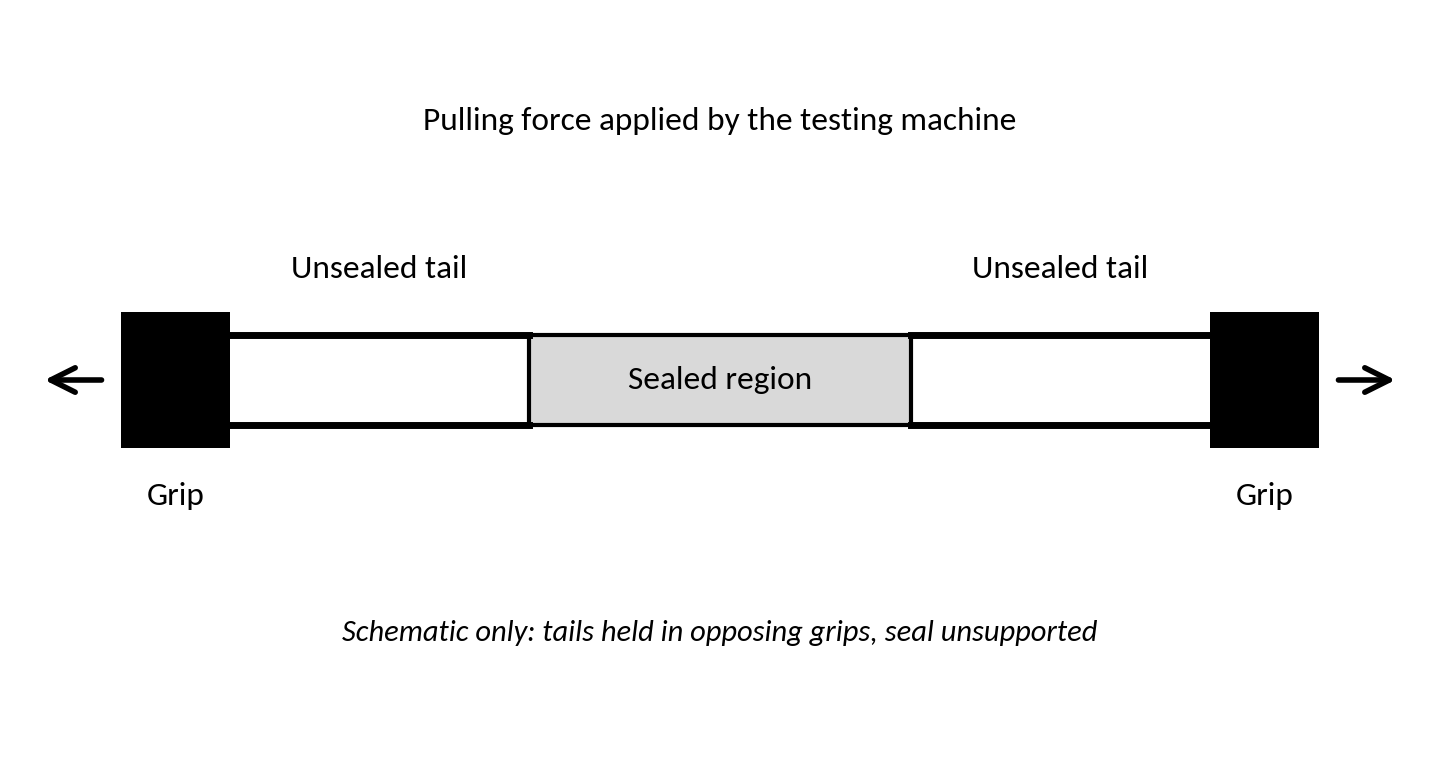
The three methods give different results, so the standard recommends using the same one for a whole series of tests. It also asks that any movement or flipping of the loose ends be reported [1].
What to report
The standard treats the highest force as essential information and says the average force can also help for some uses [1]. A complete report also names the method used, the materials, the settings used to make the seals, and how each strip broke. Without these details the force value cannot be interpreted.
How Seals Break and What It Tells You
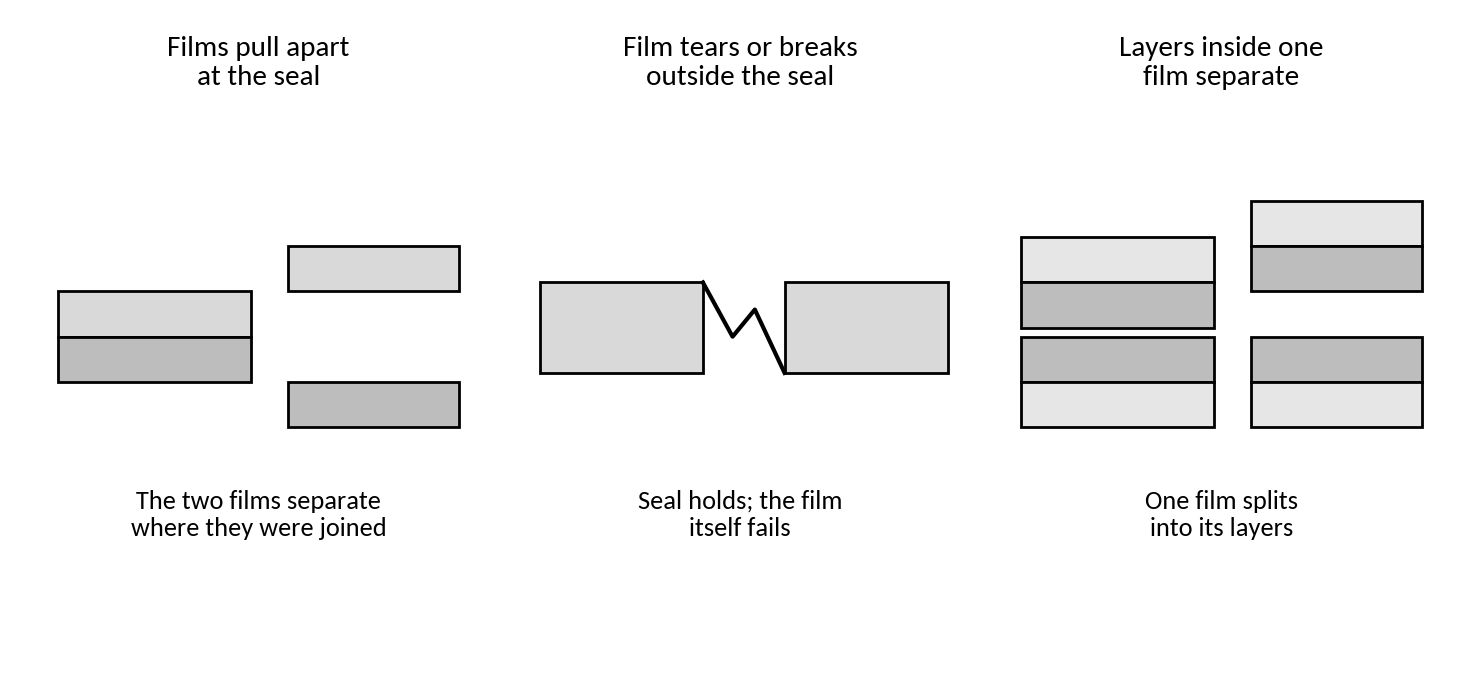
Recording how each strip breaks is part of the F88/F88M method [1]. Published work shows that strength and the way a seal breaks are closely linked [6], and the polyethylene study recorded both at every condition [5]. Reporting only an average force throws away useful information.
Laboratories often describe three kinds of break: the two films pull apart where they were joined, the film tears or snaps outside the seal, or the layers inside one film separate (Figure 4). These are everyday descriptions, not a classification defined by the sources cited here. Which kind of break is acceptable depends on the product, so the specification should say.
Peelable and permanent seals
A peelable seal is designed to open in a controlled way, so its specification needs both a minimum and a maximum force [1]. For a permanent seal, the minimum matters most. In both cases, comparing the force and the type of break with the design intent says more than the force alone.
Hot Seal Strength (Hot Tack)
Normal seal strength testing is done after the seal has cooled. Hot tack testing asks a different question: how strong is the seal just after it forms? ASTM F1921/F1921M covers laboratory measurement of this strength for plastic surfaces on flexible films, before the seal cools. It matters on packaging lines that fill and seal pouches, where fresh seals are often stressed while still hot and weak hot seals can burst [3]. ASTM F2029 says its practices do not cover hot tack [2].
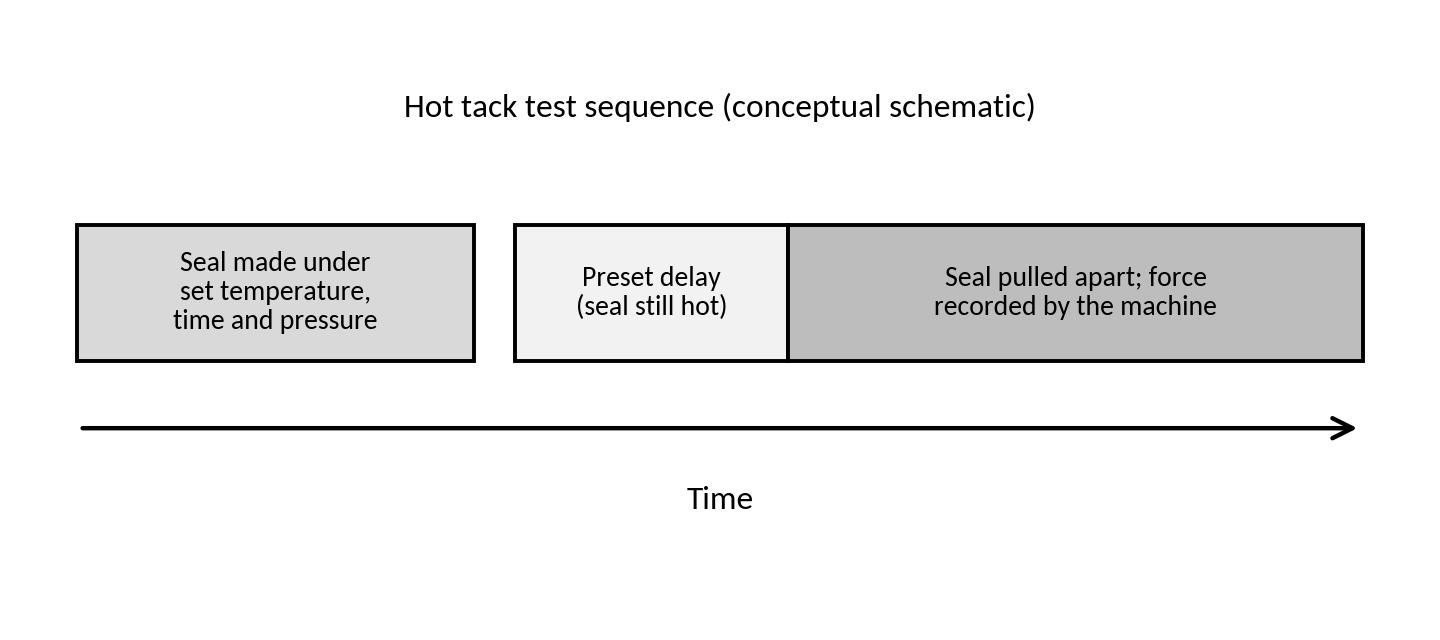
F1921 only covers machines that make the seal themselves and measure strength after a precisely timed delay. Manual methods are excluded because results can then depend on the operator [3]. In a study of contaminated seals, hot tack results did not reliably predict the strength of those seals [7]. Hot tack should therefore be reported separately and not used in place of normal seal strength.
Planning a Seal Strength Study
A well planned study gives results that are easier to defend and repeat. Figure 6 shows a general workflow. It was assembled for this article and is not taken from a single standard.
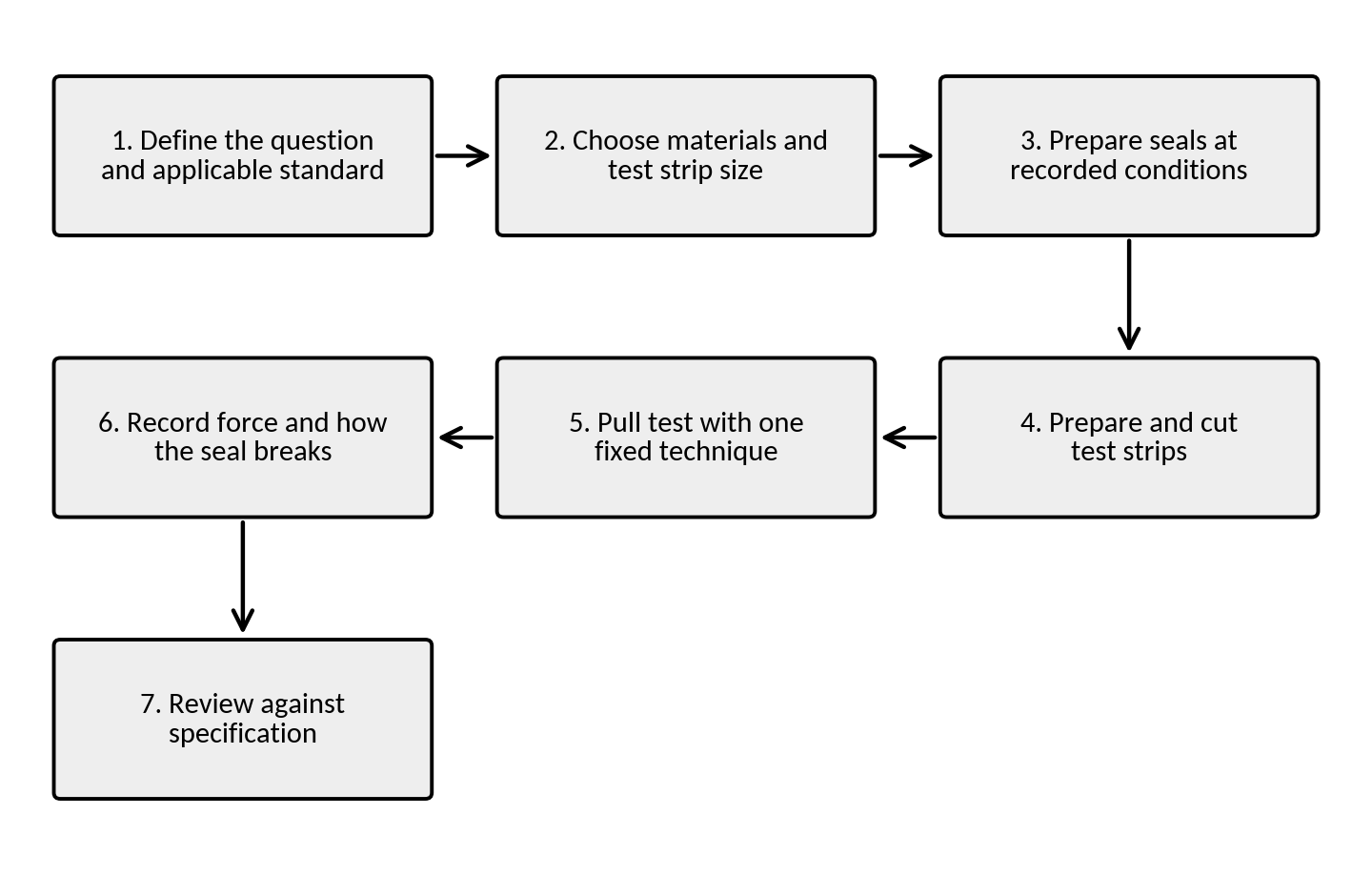
Define the question and build a test plan
Decide whether the aim is to describe a sealing layer, compare films, find the best settings, or check production samples. F88/F88M accepts seals from any source, so production seals can be tested as they are [1]. To find where strength levels off, make seals across a range of temperatures at several sealing times, with pressure kept at a recorded level. The studies cited here took this approach [5][6]. Suitable values come from the supplier and from trial runs, because no universal values exist.
Test and analyse
Cut the strips, use one pull test method throughout, and test several strips at each setting so the spread of results is visible. Take the number of strips, the storage conditions before testing and the strip size from the standard or your product specification. Plot strength against temperature for each sealing time, mark where sealing starts and where strength levels off [5], and note how the strips broke. Table 3 lists what should be recorded with the results.
| Item to record | Why it matters |
|---|---|
| Material, structure and thickness of each film | Structure and thickness affect sealing [2]. |
| Temperature of each bar, pressure and sealing time | These settings control how the seal forms [5][6]. |
| Instrument identity and calibration status | Allows results to be traced and compared between laboratories. |
| Pull test method and any fixture used | The method and fixture affect results [1]. |
| Highest force, and average force where relevant | Both may be needed depending on the use [1]. |
| How each strip broke | A required output of the F88/F88M method [1]. |
| Movement of the loose ends or other problems | Should be reported with the results [1]. |
Table 3. Information to record with seal strength results.
Some spread between strips is normal. If it is large, check the sealing settings first, then how the strips were prepared and how they were held. The choice of statistical method belongs to the laboratory's own quality system and is not prescribed here.
Quality Control and Package Integrity
Seal strength is used to check that a process stays within its limits, which is why F88/F88M ties it to proving, repeating and controlling a process [1]. For medical devices that are sterilised inside their final package, ISO 11607 Part 2 sets requirements for developing and proving forming, sealing and assembly processes [4]. Readers in that field should read the standard itself to see what must be shown.
Seal strength is not a leak test. ASTM F2029 states that leak checking, usually done by air leak tests, dye tests, visual checks or tests for microorganism entry, falls outside its scope [2]. In the contamination study, seal strength was assessed together with the share of seals that passed a dye leak test [7]. Where leaks matter, add a leak test to the strength test.
A practical troubleshooting sequence
-
Confirm the sealer ran at the recorded settings, including both bar temperatures when they are set separately.
-
Check that film direction, sealing side and sample preparation were the same for every strip.
-
Confirm the same pull test method and fixture were used, and note any movement of the loose ends [1].
-
Compare how strips broke at different settings. A change in the type of break can show that the process has moved to a different part of the sealing window, because strength and type of break are closely linked [6].
-
If strength is acceptable but leaks are suspected, add a leak test [2].
Common Problems in Heat Seal Testing
Table 4 lists problems that can reduce confidence in results, with causes supported by the sources reviewed.
| Problem | Possible causes | Source |
|---|---|---|
| Weak or incomplete bond | Temperature or sealing time too low for the polymer to melt enough. | Bond strength follows how much of the polymer melts, which depends on temperature and time [5]. Best settings differ between laminates [6]. |
| Results shaped by the test set up | Bending forces, movement of the loose ends, and the choice of fixture and grip. | ASTM F88/F88M [1]. |
| Different films behave differently at the same settings | Film structure and thickness affect sealing. | ASTM F2029 [2]. |
| Contaminated seal area | Solid material between the films. | Studied with planned statistical tests and dye leak testing [7]. |
| Hot tack results that depend on the operator | Manual methods. | Excluded from F1921 for this reason [3]. |
| Strong seal that still leaks | Strength does not prove the seal is continuous. | ASTM F2029 [2]. |
| Laboratory results that do not match production | Differences in size, seal area and speed. | ASTM F2029 [2]. |
Table 4. Common problems, possible causes and sources.
How to Choose a Laboratory Heat Sealer
No single instrument suits every laboratory. Start with the materials to be sealed, the standards you work to, and the question the testing must answer. Table 5 lists points to discuss with a supplier. They are general selection factors and do not describe any particular product.
| Point to check | Questions to ask |
|---|---|
| Materials and thickness | Which films, laminates, foils or coated papers will you seal, and how thick are they? |
| Sealing method | Do you need heated bars or impulse heating? ASTM F2029 covers both [2]. |
| Seal size | What bar length and width are needed, and how do they fit the strip size your test method requires? |
| Temperature range and control | Does the range suit your sealing layers? Can the upper and lower bars be set separately, and how is accuracy stated? |
| Pressure range and method | How is pressure created and adjusted, what does the stated range refer to, and what supplies such as compressed air are needed? |
| Sealing time range | Does it cover both the short times of fast packaging lines and longer laboratory trials? |
| Operating modes and repeatability | Is there an automatic mode, and how is the effect of the operator kept small? |
| Pull testing | How will seals be pulled to measure strength, and does the method match the F88/F88M approach you need [1]? |
| Documents, service and safety | What calibration papers, service and warranty come with it, and how are the hot bars guarded? |
Table 5. Points to check when choosing laboratory heat sealing equipment.
Safety and Good Laboratory Practice
ASTM F1921 advises operators to watch for places where fingers can be trapped as the bars close, for hot bar surfaces, and for sharp tools used to cut samples [3]. These hazards are common to all heated bar sealing. F88/F88M and F2029 both state that they do not cover every safety concern and that users must set their own safety rules [1][2]. Always follow the instrument manual for machine specific advice, including servicing, because service intervals differ between makers.
- Let the bars cool, or wear suitable protection, before handling samples or cleaning.
- Keep hands clear of the closing bars and use the guards or foot switches the instrument provides.
- Cut samples with suitable tools and label each one with its sealing settings.
Frequently Asked Questions
What is the difference between heat seal strength and hot tack?
Heat seal strength is measured after the seal has cooled, using ASTM F88/F88M [1]. Hot tack is measured just after sealing, before cooling, using ASTM F1921/F1921M [3].
Is a stronger seal always better?
No. A minimum strength keeps the package closed, while a maximum mainly applies to seals the user should be able to peel open [1].
Does higher sealing pressure always give a stronger seal?
Not always. In the polyethylene study, pressure mattered only until the films were in close contact [5]. Other materials need their own testing.
Can seal strength show whether a package leaks?
No. Leaks are found with air leak tests, dye tests and similar methods [2].
Which standard applies to a lid on a rigid container?
F88/F88M points to ASTM F2824 for pulling a whole lid off a round container [1]. Check the method your product specification requires.
Can a heat sealer measure seal strength on its own?
That depends on the instrument. F88/F88M describes measuring the force needed to separate a sealed strip [1]. Ask the supplier whether a given sealer measures force or whether seals must be pulled on a separate machine.
Conclusion
Reliable seals depend on knowing how they are made and how they are measured. Temperature, sealing time, pressure and film structure work together, and the best settings must be found for each material [2][5][6]. ASTM F88/F88M gives a clear method for measuring seal strength and recording how a seal breaks [1]. ASTM F2029 covers making laboratory seals [2], ASTM F1921/F1921M covers hot tack [3], and ISO 11607 Part 2 covers process proof for sterilised medical device packaging [4].
Good laboratory programmes record their settings, use one pull test method within a series, report how seals break, and treat seal strength as one part of a wider check on package integrity. This article gives general technical information. For any specific test, follow the current text of the relevant standard, your product specification and the instrument manual.
Relevant Testshine Product
Make Controlled Laboratory Seals with the Testshine TS-HS1 Heat Seal Tester
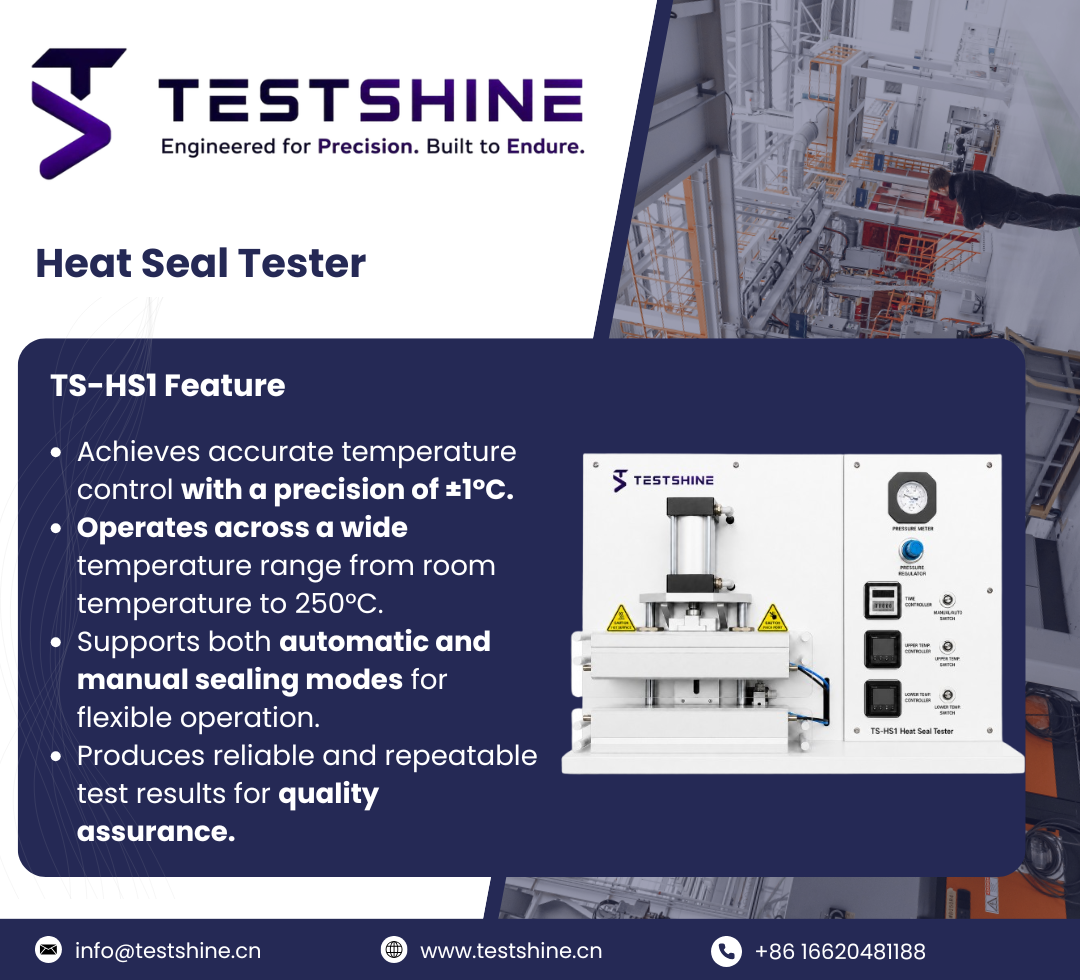
Choosing sealing temperature, pressure and time, as described in this article, needs an instrument that lets you set and repeat those values. According to the official product page, the TS-HS1 Heat Seal Tester is intended to evaluate how flexible packaging materials seal by finding suitable temperature, pressure and time [8].
Why it may suit your work:
- Temperature from room temperature up to 250 °C, with stated accuracy of ±1 °C and separate control of the upper and lower bars [8].
- A compressed air drive with a pressure range of 0 to 1 MPa [8].
- Sealing time that can be set from 0.01 s, with automatic and manual modes and a foot switch for manual use [8].
- Upper and lower bars measuring 300 mm by 10 mm, with a silicone pad on the lower bar [8].
The product page lists uses in process development, checking of incoming materials and quality testing of plastic film, composite film, coated paper and aluminium foil [8]. It does not list conformance to any standard. To discuss how seals made on the TS-HS1 can be pull tested under ASTM F88/F88M, contact the Testshine team.
References
-
ASTM International, "Standard Test Method for Seal Strength of Flexible Barrier Materials," ASTM F88/F88M, 2023 edition. ASTM product page
-
ASTM International, "Standard Practices for Making Laboratory Heat Seals for Determination of Heat Sealability of Flexible Barrier Materials as Measured by Seal Strength," ASTM F2029, 2021 edition. ASTM product page
-
ASTM International, "Standard Test Methods for Hot Seal Strength (Hot Tack) of Thermoplastic Polymers and Blends Comprising the Sealing Surfaces of Flexible Webs," ASTM F1921/F1921M, 2023 edition. ASTM product page
-
International Organization for Standardization, "Packaging for terminally sterilized medical devices, Part 2: Validation requirements for forming, sealing and assembly processes," ISO 11607 Part 2, 2019 edition. ISO product page
-
Z. Najarzadeh and A. Ajji, "A novel approach toward the effect of seal process parameters on final seal strength and microstructure of LLDPE," Journal of Adhesion Science and Technology, volume 28, issue 16, pages 1592 to 1609, 2014. Publisher record (DOI)
-
S. Y. Cheng, M. I. Ghazali, A. Hassan and A. F. Ismail, "Heat sealability of laminated films with LLDPE and LDPE as the sealant materials in bar sealing application," Journal of Applied Polymer Science, volume 104, page 3736, 2007. Publisher record (DOI)
-
B. Bamps, K. D'huys, I. Schreib, B. Stephan, B. De Ketelaere and R. Peeters, "Evaluation and optimization of seal behaviour through solid contamination of heat sealed films," Packaging Technology and Science, volume 32, issue 7, pages 335 to 344, 2019. Research portal record
-
Testshine Co., Ltd., "Heat Seal Tester TS-HS1," official product page. Testshine product page
Related Posts
Mechanical and Seal Integrity Testing for Flexible Packaging: A Guide to Quality Assurance

Tensile Strength and Elongation Testing for Flexible Packaging Films

Flexible Packaging Quality Control: Essential Testing Methods and Standards

Coefficient of Friction Testing for Flexible Packaging: Why Surface Friction Matters
Mechanical and Seal Integrity Testing for Flexible Packaging: A Guide to Quality Assurance
Tensile Strength and Elongation Testing for Flexible Packaging Films
Flexible Packaging Quality Control: Essential Testing Methods and Standards