
Quality Control and Testing of Paper
Quality Control and Testing of Paper
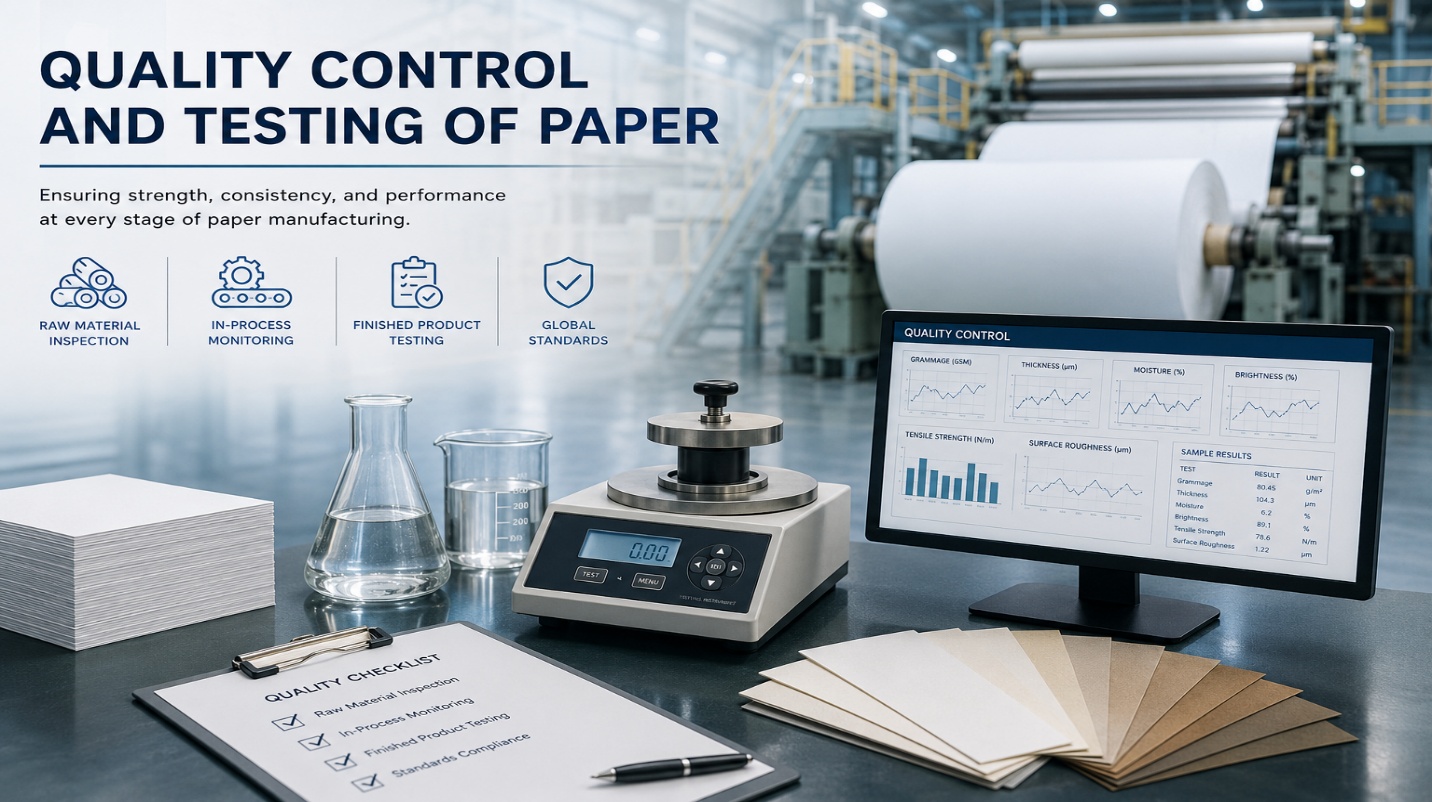
A clear overview of raw material checks, in process monitoring, finished product testing, and global standards in the paper industry
1. Introduction
Paper is one of the most widely used materials in the world. It appears in packaging, books and printing, hygiene products, and many industrial and specialty items. Before a roll of paper leaves a mill, it goes through many checks and tests to make sure it will perform correctly once it reaches a printer, a converter (a business that turns raw paper into boxes, bags, or other finished items), or the end customer. Quality control in paper making is the organized process of checking raw materials, the steps carried out during production, and the finished sheets or boards, to confirm that they consistently meet set requirements for strength, appearance, printing performance, machine handling, and overall use.
Unlike many manufactured goods that can only be checked after they are made, the quality of paper is shaped continuously. It starts the moment wood chips or recycled fiber enter the pulp making process, and continues through refining, sheet forming, pressing, and drying, all the way to the final roll. A problem introduced at any single step, such as uneven fiber drainage or a change in dryer temperature, can carry through the entire production run and only appear later as a customer complaint. For this reason, quality control in paper making is not a single inspection step. It is a complete system that connects laboratories, the production floor, and quality teams.
This article gives a clear, detailed look at paper quality control. It covers checking raw materials, monitoring the production process, testing finished paper, the instruments used in paper testing laboratories, common defects and their causes, the international standards that guide testing methods, and the wider role quality control plays in sustainability, digital technology, and competitiveness in today's pulp and paper industry.
2. Why Quality Control Matters in the Paper Industry
Paper mills run continuous, high speed production lines. Machines can be wider than eight meters and can run faster than a thousand meters per minute. At this scale, even a small problem in raw material quality or process settings can lead to large amounts of product that fail to meet specification, costly downtime, and significant waste. A well organized quality control programme protects the business in several connected ways.
- Saves cost: Finding a fiber or chemical problem at the raw material stage is far cheaper than discovering it after a whole roll has been produced, cut, and shipped.
- Builds customer trust: Converters, printers, and packaging companies build their own processes around guaranteed paper properties. Consistent quality data builds long term trust and repeat business.
- Meets legal and contract requirements: Many paper types, especially those used for food packaging, currency, or medicine boxes, must meet strict legal and customer set limits.
- Improves efficiency: Real time process data lets operators make corrections before a small problem turns into a major production issue. This reduces waste paper that must be reprocessed and reduces machine downtime.
- Protects brand and reputation: A single batch of inconsistent paper reaching a major client can damage a business relationship built over many years.
In short, quality control in paper making is not a cost to be reduced. It is a valuable function that supports efficiency, customer satisfaction, and long term profit.
3. Overview of the Paper Manufacturing Process
To understand where and why quality checks are placed, it helps to look briefly at how paper is made. The process starts with preparing pulp, either freshly made from wood fiber or recovered from recycled paper. This pulp is thinned, refined, and mixed with fillers and functional chemicals in what is called the stock preparation stage. The resulting mixture, often called furnish, is spread onto a moving wire screen, where the sheet begins to form as water drains away and fibers bond together. The wet sheet then passes through a press, where mechanical pressure removes more water, before entering the dryer section, where a series of heated rollers evaporate the remaining moisture. Finally, the finished sheet is wound into rolls, smoothed if required, and cut or rewound into the roll or sheet sizes that customers order.
Quality checks are built into every one of these stages, not just carried out on the finished product. This allows problems to be corrected almost immediately, instead of being discovered only after a full roll is complete.
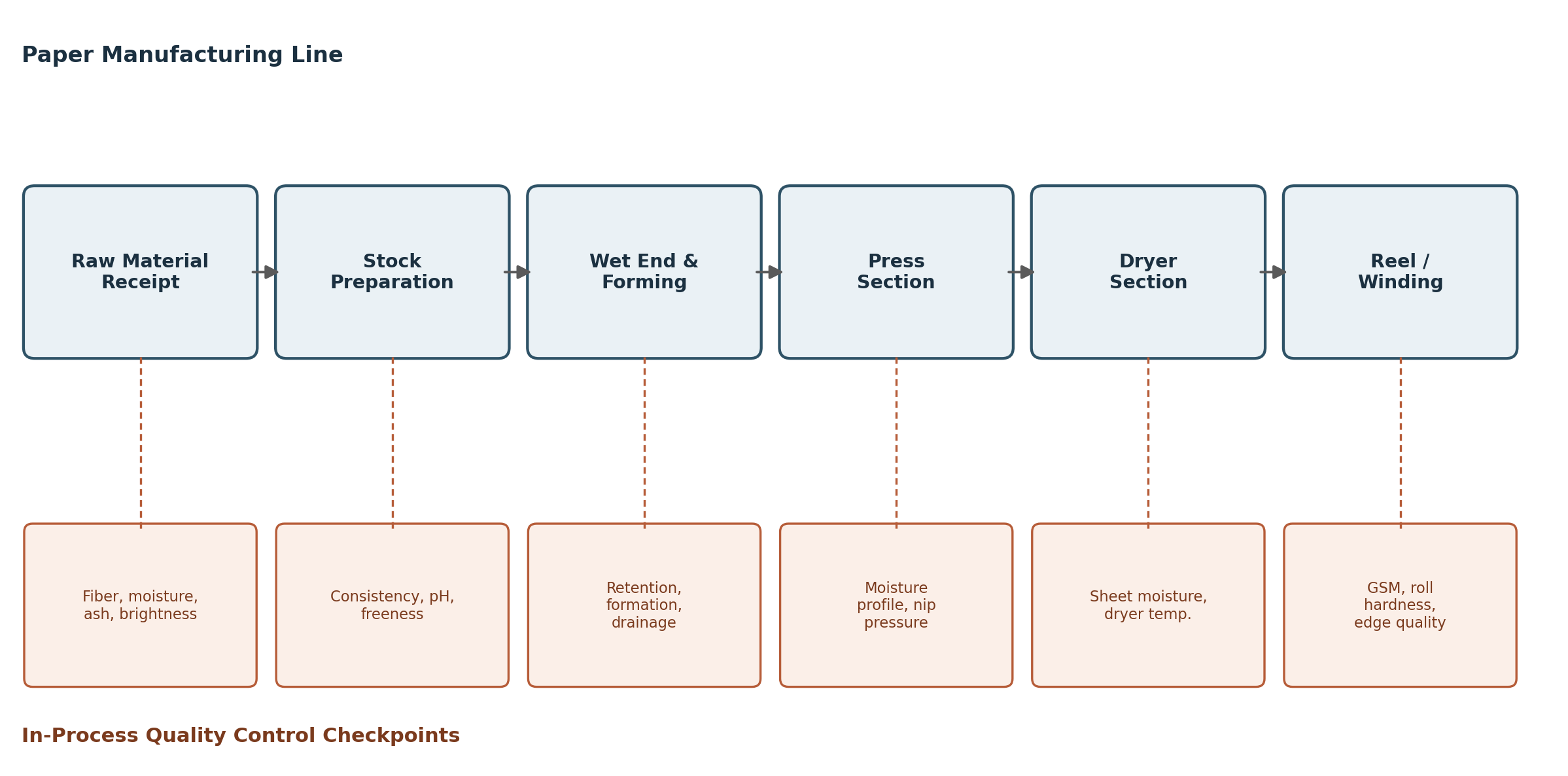
Figure 1: Paper manufacturing line with quality checks built into each production stage.
4. Raw Material Quality Control
Checking raw materials is the first, and arguably the most important, line of defense in paper quality control, because no adjustment made later in the process can fully make up for input material that is fundamentally inconsistent. Three broad groups of incoming raw materials are routinely tested before they are released into production.
4.1 Wood Pulp
Virgin wood pulp (pulp made fresh from wood rather than recycled paper) is checked for moisture content, brightness, dirt count, fiber length and width, freeness (how quickly water drains from it), ash content, the proportion of cellulose and lignin (natural wood components), acidity or alkalinity (pH), and viscosity. Together, these measurements show how the pulp will behave during refining and sheet forming, and how the finished paper will look and perform.
4.2 Recycled Fiber
Recovered paper brings extra variables that are not present in virgin pulp: moisture, ash, plastic and metal contamination, stickies (adhesive residues that can cause problems running through the machine), ink content, the amount of usable fiber it yields, and dirt count. Because the quality of recycled material can vary a great deal between supply batches, checking it on arrival is essential to stop contamination from reaching the paper machine.
4.3 Fillers and Chemicals
Mineral fillers (such as calcium carbonate or kaolin clay) and functional chemicals (sizing agents, retention aids, strength additives, and optical brighteners) are checked for particle size, purity, pH, moisture, viscosity, and solids content, since even small differences in these properties can significantly change how they behave when added to the stock preparation system.
5. Process Quality Control During Production
Once raw materials are approved, quality monitoring continues throughout the production line. Monitoring during production relies on a mix of laboratory sampling and, increasingly, continuous sensors that feed data directly into the mill's process control system.
5.1 Stock Preparation
Pulp consistency (the percentage of fiber solids in the mixture), pH, conductivity, temperature, freeness, and fiber length are monitored to make sure the mixture delivered to the paper machine is uniform from batch to batch.
5.2 The Wet End
Retention (the proportion of fiber and filler that stays in the sheet rather than draining away), the solids left in the white water, drainage rate, and sheet formation are tracked, since these factors directly determine how uniform the weight of the sheet is and how good its visual formation looks.
5.3 Press Section
Moisture levels across the width of the sheet and pressure at the press nip are monitored to ensure water is removed evenly, which affects both drying efficiency later on and the dimensional stability of the finished paper.
5.4 Dryer Section
Steam pressure, sheet moisture, and the temperature of the dryer cylinders are checked continuously, since improper drying can cause curling, cockling, or uneven moisture that leads to problems when the customer runs the paper through their own converting or printing equipment.
5.5 Reel Section
At the reel, roll hardness, edge quality, and moisture uniformity are checked before the finished parent roll is passed on for slitting, rewinding, or further finishing.
6. Finished Paper Testing
Finished product testing confirms that the paper leaving the mill will perform as required once it reaches the customer's converting, printing, or packaging line. Tests fall into seven broad groups, each focused on a different aspect of paper performance.
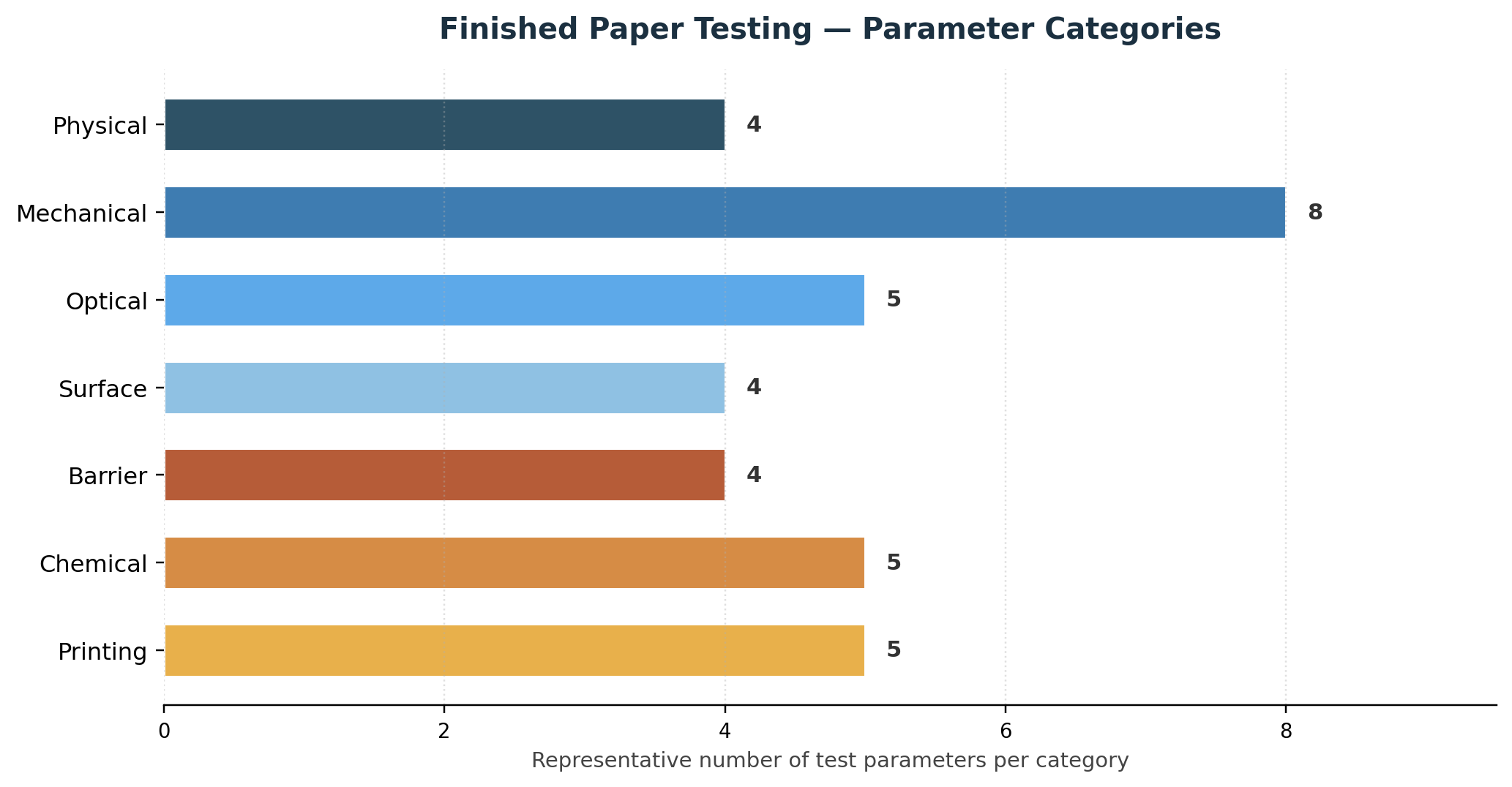
Figure 2: Typical spread of test parameters across the seven finished paper testing categories.
6.1 Physical Properties
Basic physical measurements include grammage, also called GSM, meaning grams per square meter (ISO 536), thickness (ISO 534), density, and bulk. These form the baseline specification that almost every other property is measured against, since strength and optical values mean little without knowing the weight and thickness of the sheet being tested.
6.2 Mechanical Properties
Mechanical testing checks how well the paper withstands the physical stress of converting, printing, and everyday use. This includes tensile strength (ISO 1924), tear resistance (ISO 1974), burst strength (ISO 2758), the Ring Crush Test, the Edge Crush Test, the Box Compression Test, folding endurance, and stiffness. These properties matter most for packaging and corrugated board, where stacking strength and resistance to dropping determine whether a shipped product arrives undamaged.
6.3 Optical Properties
Optical testing covers brightness (ISO 2470), whiteness (ISO 11475), opacity (ISO 2471), gloss, and colour. These properties affect print quality and how appealing the finished paper looks, and matter most for premium printing and writing grades.
6.4 Surface Properties
Surface characteristics, including smoothness, roughness, air permeability, and surface strength, determine how well ink transfers during printing and how the sheet feels and behaves when it is handled or fed through high speed equipment.
6.5 Barrier Properties
Barrier performance matters most for packaging and includes water absorption measured by the Cobb test (ISO 535), water vapour transmission rate, oxygen transmission rate, and resistance to grease and oil. These properties determine how well the paper protects its contents from moisture, gases, or fats.
6.6 Chemical Properties
Chemical testing checks pH, ash content, chloride and sulphate levels, heavy metals, and optical brighteners. These are especially important for food contact packaging and other specialty grades that must meet regulatory limits.
6.7 Printing Properties
Finally, print related testing checks ink absorption, rub resistance, print gloss, dot gain, and drying time, giving printers and converters confidence that the paper will reproduce images and text accurately and consistently on their equipment.
7. Laboratory Instruments Used in Paper Testing
A well equipped paper testing laboratory combines general purpose measuring tools with instruments built specifically for pulp and paper testing. Common equipment includes the Universal Testing Machine for tensile and compression tests, a GSM cutter and precision balance for measuring basis weight, a digital micrometer for measuring thickness, and a moisture analyzer for quick moisture checks.
Strength testing relies on dedicated instruments such as the burst strength tester, the Elmendorf tear tester, the ring crush tester, the edge crush tester, and the box compression tester. Surface and barrier properties are assessed using the Cobb tester for water absorption, the Gurley air permeability tester, and the Bekk smoothness tester. Optical testing is carried out with a brightness and opacity meter, a gloss meter, and a spectrophotometer, while chemical analysis relies on a pH meter and a muffle furnace for measuring ash. Fiber level testing uses a fiber analyzer and a freeness tester, and printability is assessed with an IGT printability tester. A folding endurance tester completes the core equipment list used to check how well a sheet withstands repeated flexing.
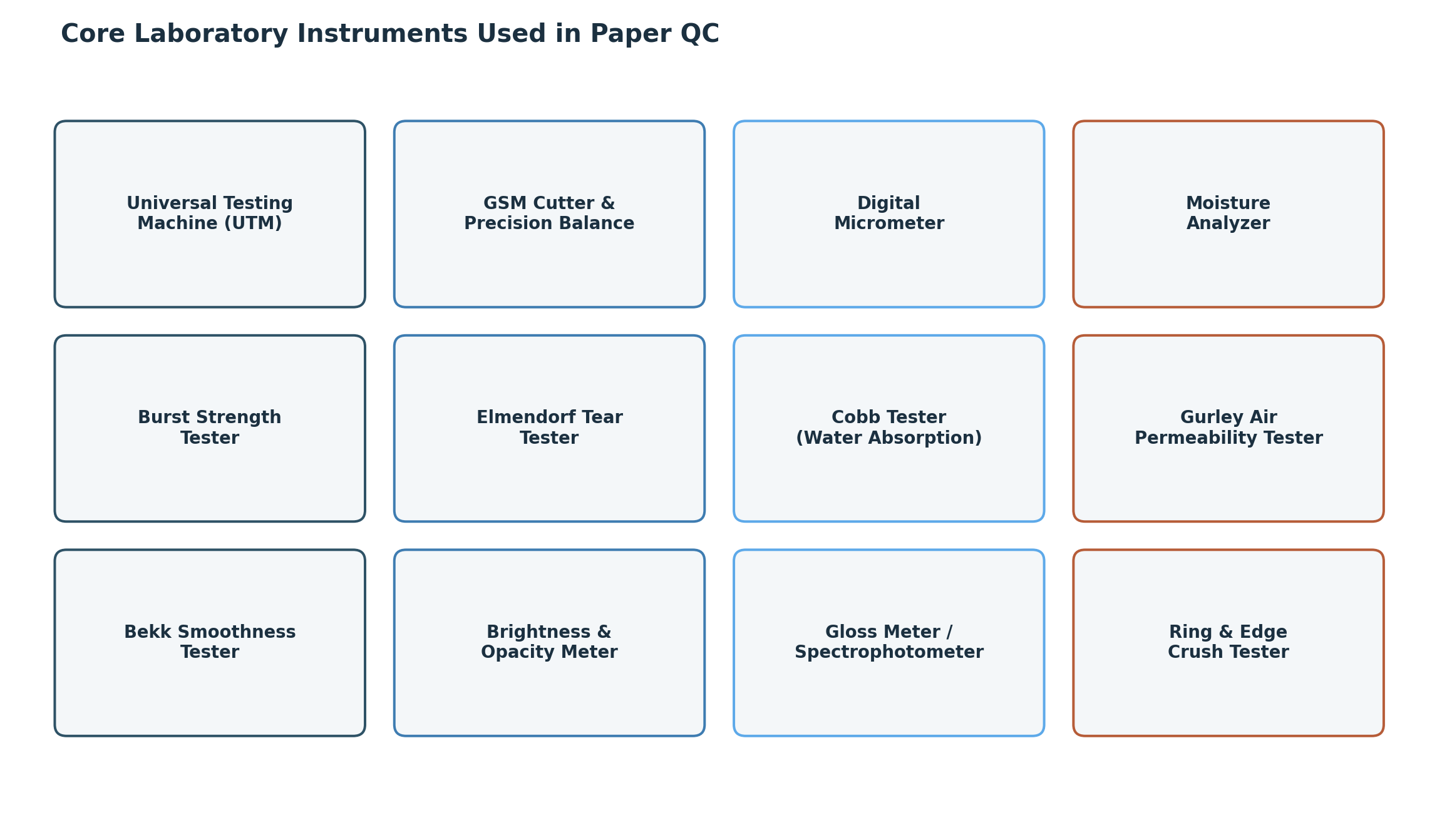
Figure 3: Core instruments typically found in a pulp and paper testing laboratory.
8. Common Defects in Paper and Their Root Causes
Even in well controlled processes, paper defects can still occur, and knowing their typical root causes helps quality and production teams respond quickly. Common defects include uneven GSM and thickness, holes, wrinkles, dirt spots, colour variation, curl, waviness, delamination (layers separating), low strength, high moisture, poor formation, dusting or linting, and poor printability.
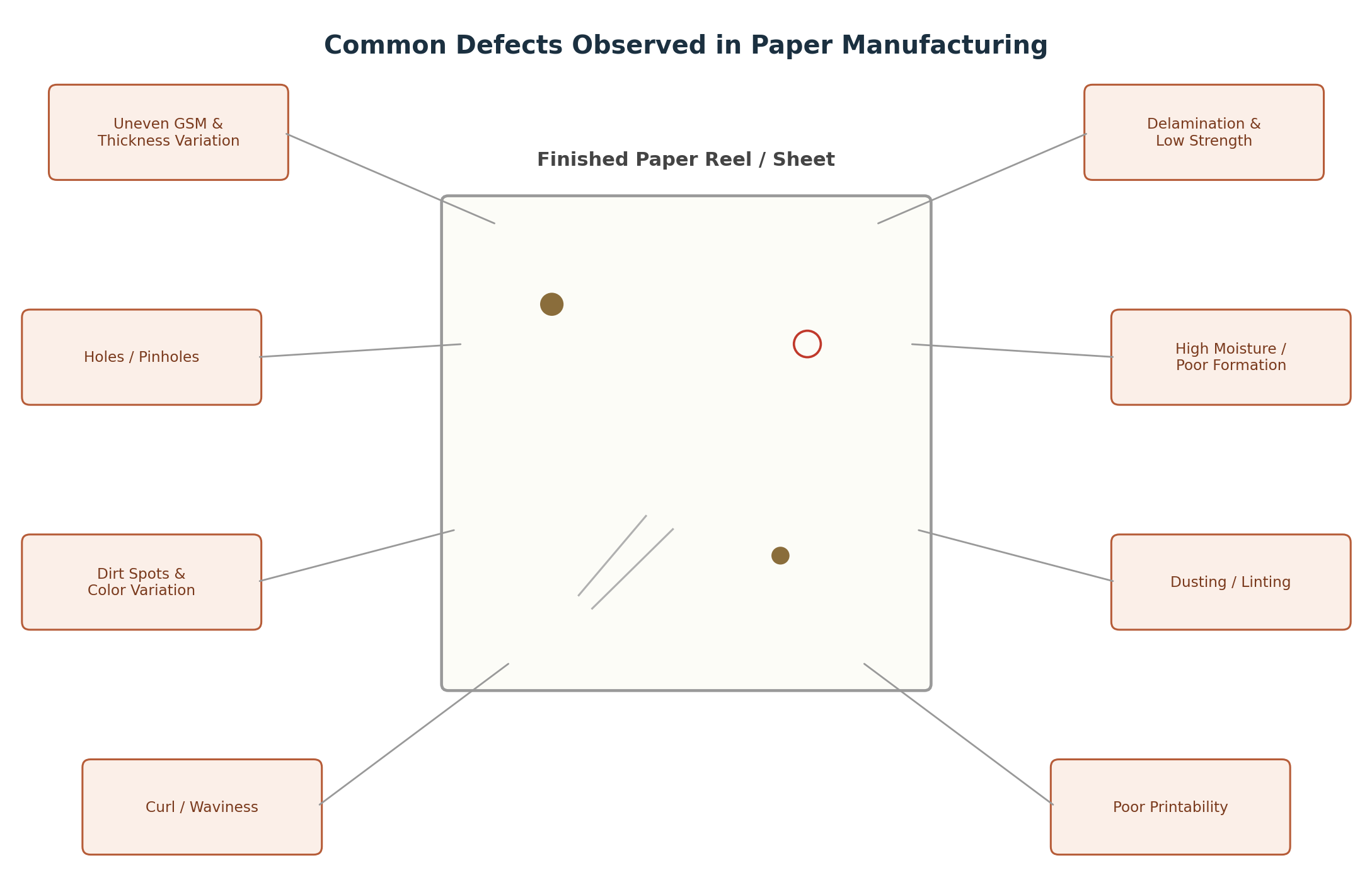
Figure 4: Common visual and functional defects seen in finished paper.
| Defect | Typical root cause |
|---|---|
| Uneven GSM or thickness | Inconsistent stock flow, an unbalanced headbox slice, or worn press rolls |
| Holes or pinholes | Contamination, air bubbles in the mixture, or foreign material on the wire |
| Wrinkles | Uneven tension across the sheet width or misaligned rolls |
| Dirt spots or colour variation | Contaminated furnish, poor washing of recycled fiber, or additive dosing errors |
| Curl or waviness | Uneven moisture across the sheet or drying and coating on only one side |
| Delamination or low strength | Poor fiber bonding, insufficient refining, or inadequate wet end chemistry |
| High moisture or poor formation | Insufficient drying capacity or uneven drainage at the wet end |
| Dusting or linting | Weak surface bonding or too much filler content |
| Poor printability | Surface roughness, incorrect sizing, or inconsistent ink holdout |
9. International and Industry Testing Standards
Consistency across the global paper industry depends on standardized test methods, so that a result produced in one laboratory can be trusted and compared with a result produced anywhere else in the world. The most widely used standards bodies are the International Organization for Standardization (ISO), the Technical Association of the Pulp and Paper Industry (TAPPI), and the American Society for Testing and Materials (ASTM), along with regional standards issued by national bureaus.
| Standard | Property measured |
|---|---|
| ISO 536 | Grammage (basis weight, GSM) |
| ISO 534 | Thickness and apparent density |
| ISO 1924 | Tensile properties |
| ISO 1974 | Tearing resistance (Elmendorf method) |
| ISO 2758 | Bursting strength |
| ISO 535 | Water absorption (Cobb method) |
| ISO 2470 | Brightness |
| ISO 2471 | Opacity |
| ISO 11475 | CIE whiteness, D65/10 degree illuminant |
| ISO 5627 | Smoothness (Bekk method) |
In addition to these ISO methods, many mills also check results against equivalent TAPPI test methods and ASTM standards, particularly for markets such as North America, where these frameworks are the main regulatory or contractual reference.
10. Sampling and Statistical Process Control in Paper Quality Control
Since it is impossible to test every square meter of paper produced, laboratories use structured sampling plans, typically taking strips across the width of the sheet at set intervals along a roll, to obtain results that fairly represent the whole production run. Results are then plotted on Statistical Process Control charts, which track key parameters such as GSM, moisture, and brightness against upper and lower control limits over time.
Statistical Process Control lets quality engineers tell the difference between normal, expected variation and a genuine shift that needs investigation, well before the deviation becomes large enough to be visually obvious or to cause customer complaints. Trend analysis, control charts, and capability indices such as Cpk are now standard tools in most modern paper mill quality departments, and they feed directly into continuous improvement and root cause investigation work.
11. The Quality Assurance Framework: Bringing It Together
Raw material inspection, monitoring during production, and finished product testing do not work in isolation. They form a layered assurance framework in which each level builds on the reliability of the one below it. Consistent raw materials make process control more predictable, and stable conditions during production in turn make finished product testing a confirmation exercise rather than a source of surprises. Certification against recognised international standards then gives customers independent, third party confidence in the results a mill reports.
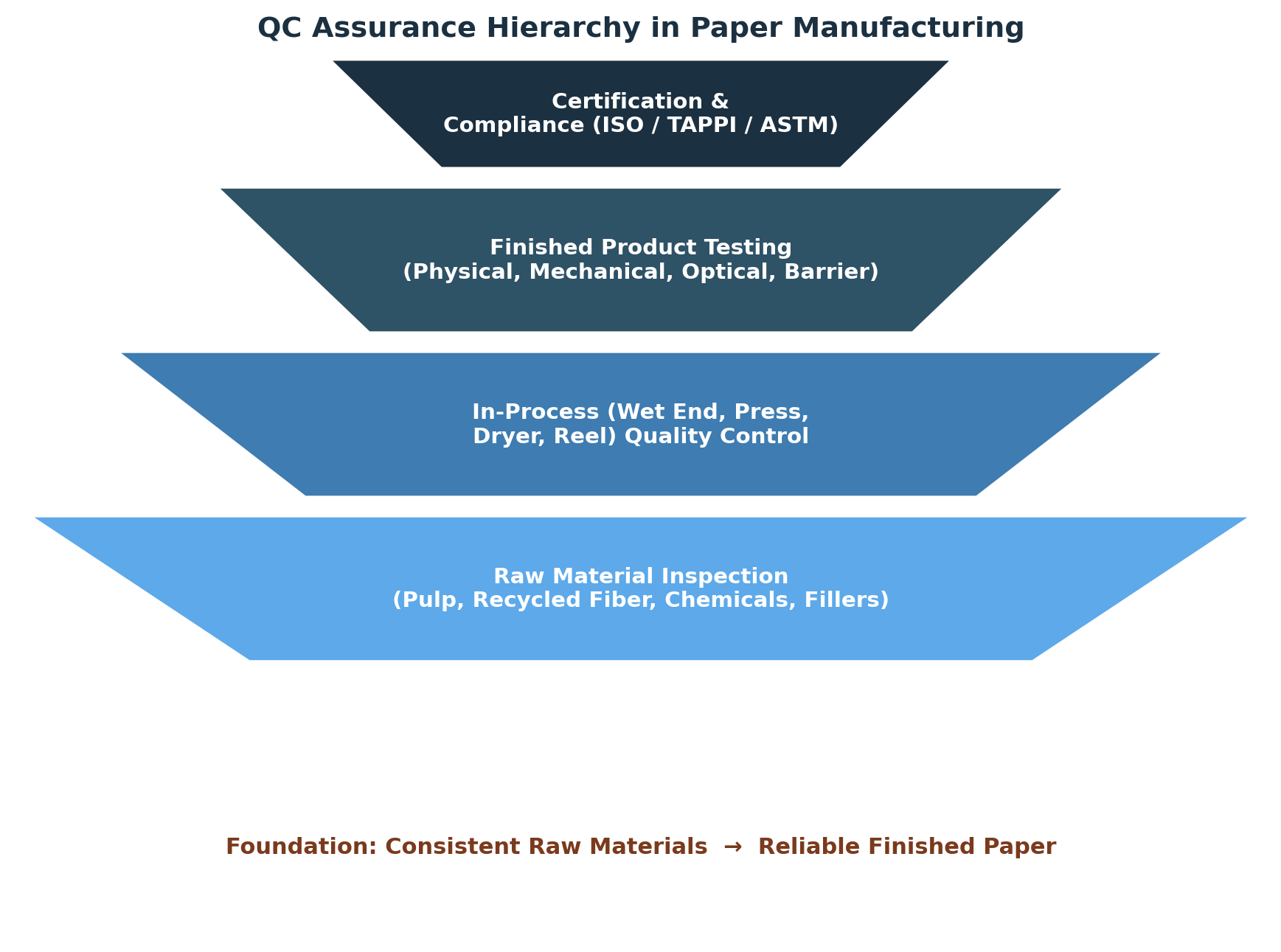
Figure 5: The layered quality control hierarchy, from raw material inspection through to certification and compliance.
12. The Role of Quality Control in Sustainability and Environmental Compliance
Modern paper quality control reaches well beyond product performance into environmental responsibility. Because pulp and paper manufacturing uses large amounts of water and energy, tight process control directly reduces resource use. Consistent stock preparation and drainage performance reduce fiber and chemical waste, accurate moisture control reduces the energy needed for drying, and lower reject and waste rates mean less reprocessing and less water treatment load.
Quality control laboratories are also increasingly responsible for confirming compliance with environmental and food contact regulations, testing for restricted substances, confirming recycled content claims, and checking that packaging grades meet migration limits for chemicals that could transfer into food. As sustainability certifications such as FSC and PEFC chain of custody schemes, along with recycled content and biodegradability claims, become more commercially important, the quality control function is often the department that produces and defends the data behind these claims.
13. Digital Transformation: Automation, Sensors, and Artificial Intelligence in Paper Quality Control
Traditional paper quality control relied heavily on periodic manual sampling and offline laboratory testing, which meant a defect could run through a large length of the machine before it was found and corrected. Modern mills increasingly use on line scanning sensors, including beta ray or infrared gauges for basis weight and moisture, and camera based systems for formation and surface defects, that measure properties continuously across the full width and length of the sheet as the machine runs.
These sensor networks feed data into control systems and, increasingly, into machine learning models that can predict an emerging problem before it crosses a control limit, allowing operators to make a correction ahead of time rather than reacting afterward. Laboratory information management systems now link offline test results with online process data, giving quality engineers a single, searchable record that connects a customer complaint back to the exact roll, shift, and process condition that produced it. This coming together of laboratory testing, online sensing, and data analytics is often described as the digitalisation of paper quality control, and it is becoming a key competitive difference between mills.
14. Challenges in Implementing Effective Paper Quality Control
- Raw material variability: Recycled fiber in particular can vary a great deal in composition from batch to batch, making it harder to keep process settings consistent.
- High speed, continuous production: Paper machines run continuously at high speed, leaving a very narrow window to detect and correct a problem before large volumes of off specification product are made.
- Balancing cost and testing frequency: More frequent sampling and testing improves detection but adds labour cost and can slow production if it is not properly built into the workflow.
- Instrument calibration and correlation: Different instruments, or the same type of instrument from different manufacturers, can give slightly different readings, so ongoing calibration and cross laboratory comparison are essential to keep results comparable.
- Skilled workforce requirements: Interpreting Statistical Process Control data, operating precision testing equipment, and diagnosing root causes all require trained technicians and engineers, and a shortage of these skills can limit how well a quality programme is run.
- Evolving regulatory requirements: Food contact, packaging, and environmental regulations keep changing across different export markets, requiring quality teams to continuously update their testing scope and documentation.
15. Best Practices and Future Outlook
Mills that achieve the strongest quality results typically combine several practices. They invest in online sensing to catch problems early, maintain thorough raw material qualification procedures for every new supplier batch, use Statistical Process Control and capability analysis rather than relying only on pass or fail checks, and treat their quality laboratory as an integrated part of the production process rather than a separate, downstream checkpoint.
Looking ahead, paper quality control is moving toward closer integration between laboratory, process, and business systems, greater use of predictive analytics to anticipate quality issues before they happen, and continued growth in sustainability related testing as regulatory and customer expectations around recycled content, biodegradability, and chemical safety keep rising. Mills that build this integrated, data driven quality culture will be best placed to meet increasingly demanding customer specifications while also reducing waste and environmental impact.
16. Conclusion
Quality control and testing in paper manufacturing is a continuous, multi layered discipline. It begins with raw material inspection, continues through monitoring at every stage of the machine, and ends in thorough finished product testing against internationally recognised standards. Far from being a final checkpoint, effective quality control is built into the entire production process, supported by dedicated laboratory instruments, structured sampling and statistical methods, and, increasingly, digital sensing and analytics. As the industry continues to modernise and sustainability expectations rise, the mills that treat quality as a core part of how they operate, rather than an afterthought, will be the ones best equipped to deliver consistent, high performing paper to a demanding global market.