
Tensile Strength and Elongation Testing for Flexible Packaging Films
Introduction
A flexible package has a hard life. The film is printed, joined to other layers, formed into a pouch or wrap, filled, sealed, shipped and finally handled by a customer. Each stage pulls, stretches or squeezes the material. Laboratories check whether a film can cope with this by measuring its mechanical properties, and a tensile test is one of the most widely used ways to do it.
In a tensile test, a narrow strip of film is gripped at both ends and pulled at a set speed until it breaks. The machine records the load on the strip and how far it stretches. From these records a laboratory can report how strong the film is, how far it stretches before breaking, and how stiff it is. ASTM D882 covers this test for thin plastic sheeting under 1.0 mm thick [1]. ISO 527 Part 3 covers plastic films and sheets under 1 mm thick [2].
This article explains the main terms in plain language, shows how a film tensile test works, lists what can change the result, and explains how to read the data. It also covers common problems, the limits of the test, and what to look for when choosing a tensile testing machine. It does not give pass or fail limits or test settings, because these depend on the film, how it is processed, how it is used and which standard applies.
Why Tensile and Elongation Results Matter
Guidance on specifying flexible packaging lists tensile properties among the film attributes worth measuring, next to thickness, tear strength, puncture and impact resistance, heat seal behavior and barrier performance [8]. ASTM D882 says tensile results help identify and describe materials for control and specification, and can support research, design and quality control [1].
The same standard also sets a limit. Tensile results may not be meaningful for uses that are very different from the loading speed and type of the test [1]. A strip pulled slowly in a laboratory does not copy every load a package meets in real life. Treat tensile results as a controlled way to compare films, not as a full forecast of how a package will perform.
Typical uses include comparing film grades, checking incoming rolls against a specification, judging a change in material or process, and investigating a failure. All of these need a test that is run the same way every time and is fully recorded.
What the Key Terms Mean
Words such as strength and elongation are used loosely on supplier data sheets, so it helps to be precise. The table gives general descriptions only. The exact definitions and calculation rules come from the standard you follow, and every report should name that standard.
| Term | Plain description | Point to watch |
|---|---|---|
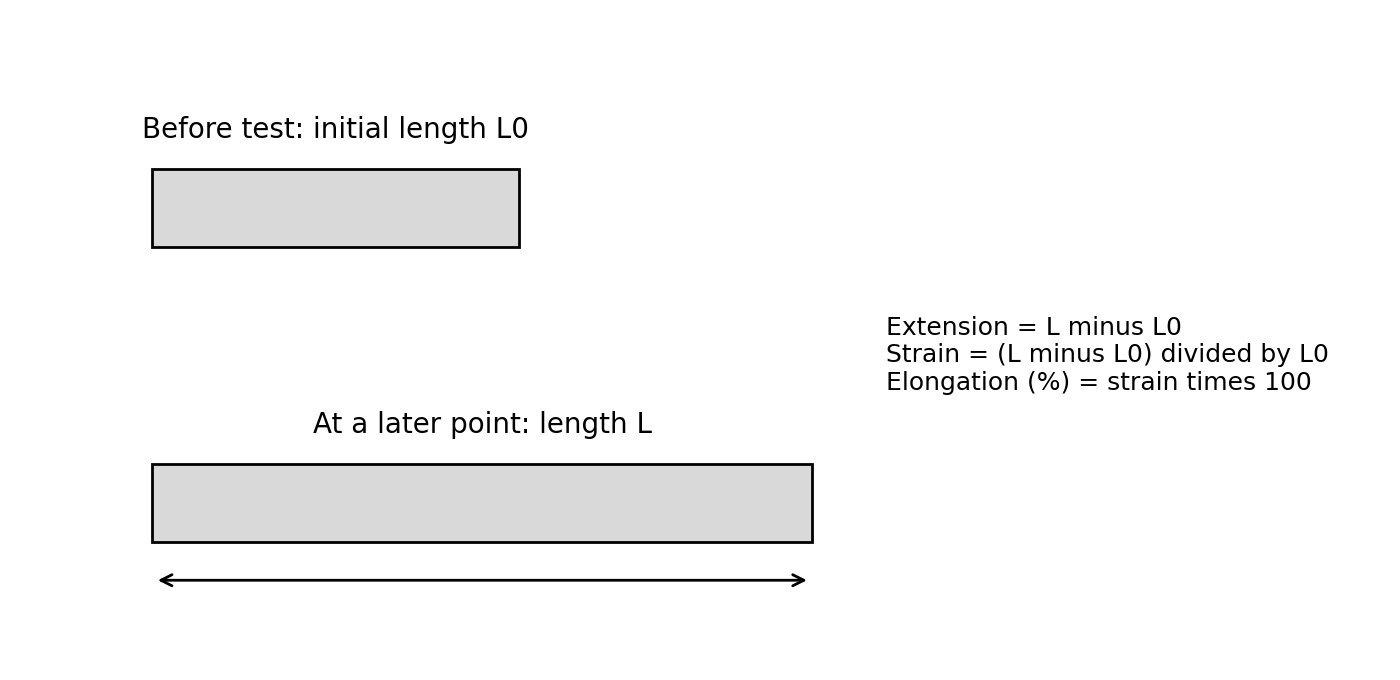
| Stress and strain | Stress is the load on the strip divided by its starting cross section. Strain is how much the strip has stretched compared with its starting length. | Stress depends on measured width and thickness, so a thickness error goes straight into the result. |
| Tensile strength | In general terms, the highest stress the strip carries during the test. ISO 527 Part 1 covers how tensile strength and stiffness are determined under defined conditions [3]. | A material may be reported at its yield point, at break, or both. Say which one you mean. |
| Yield | The point where the film starts to stretch permanently instead of springing back. | Some films have no clear yield point. |
| Elongation at break | How much longer the strip is at the moment it breaks, given as a percentage of its starting length. | The result depends on how the stretch is measured: by grip movement, by a measuring device on the strip, or by marks on the strip [1]. |
| Tensile modulus | A measure of stiffness. ASTM D882 calls it an index of the stiffness of thin plastic sheeting [1]. | Compare stiffness only between strips of the same dimensions [1]. |
| Tensile energy to break | The total energy the film absorbs per unit of volume before it breaks [1]. | ASTM warns that test speed, strip size and especially flaws can cause large differences [1]. |
ASTM D882 and ISO 527 Part 3: The Main Standards
Most film tensile testing in packaging laboratories follows one of two documents, or a customer specification that points to one of them. The table lists the standards used in this article, using the scope statements and status shown on the publishers' catalogue pages on 31 October 2026. The full standards are paid documents and were not reproduced, so details such as strip width, distance between grips and test speed are left out on purpose.
| Standard | Published title | What it covers | Status shown |
|---|---|---|---|
| ASTM D882 (2026a edition) | Standard Test Method for Tensile Properties of Thin Plastic Sheeting | Tensile properties of plastic in the form of thin sheeting and film under 1.0 mm thick. Thicker material is covered by ASTM D638 [1]. | Active, last updated 1 October 2026. |
| ISO 527 Part 3 (2018 edition) | Plastics: Determination of tensile properties. Part 3: Test conditions for films and sheets | Test conditions for films or sheets under 1 mm thick, built on ISO 527 Part 1. Not normally suitable for foams or for plastics reinforced with textile fibers [2]. | Published, 2nd edition, confirmed in 2024. |
| ISO 527 Part 1 (2019 edition) | Plastics: Determination of tensile properties. Part 1: General principles | General principles for determining tensile properties. Specimen types are given in the later parts [3]. | Published, 3rd edition, confirmed in 2025, listed as due for revision. |
| ASTM D618 (2021 edition) | Standard Practice for Conditioning Plastics for Testing | How to condition plastics before testing. The conditioning does not always bring the material to full balance [4]. | Active. |
| ISO 4593 (1993 edition) | Plastics: Film and sheeting. Determination of thickness by mechanical scanning | Measuring film thickness by mechanical scanning. Not suitable for embossed film [5]. | Published, confirmed in 2025. |
| ISO 7500 Part 1 (2018 edition) | Metallic materials: Calibration and verification of static uniaxial testing machines. Part 1: Tension/compression testing machines. Calibration and verification of the force measuring system | Calibration and checking of the load measuring system of tension and compression testing machines [6]. | Published, 5th edition, confirmed in 2023. |
ASTM D882 describes itself as technically similar to ISO 527 Part 3 [1]. Similar does not mean identical. Before treating results from one standard as equal to the other, compare the strip type, test speed and the way stretch is measured.
ISO 7500 Part 1 is written for machines that test metals [6]. A film laboratory should ask its customers, its accreditation body and its machine supplier which checking scheme suits a low load film tester.
Neither film standard covers every flexible packaging material. Both deal with material under 1 mm thick, and thicker sheet is sent to other documents [1][2]. Always check which edition applies to your material.
How a Film Tensile Test Works
The basic idea
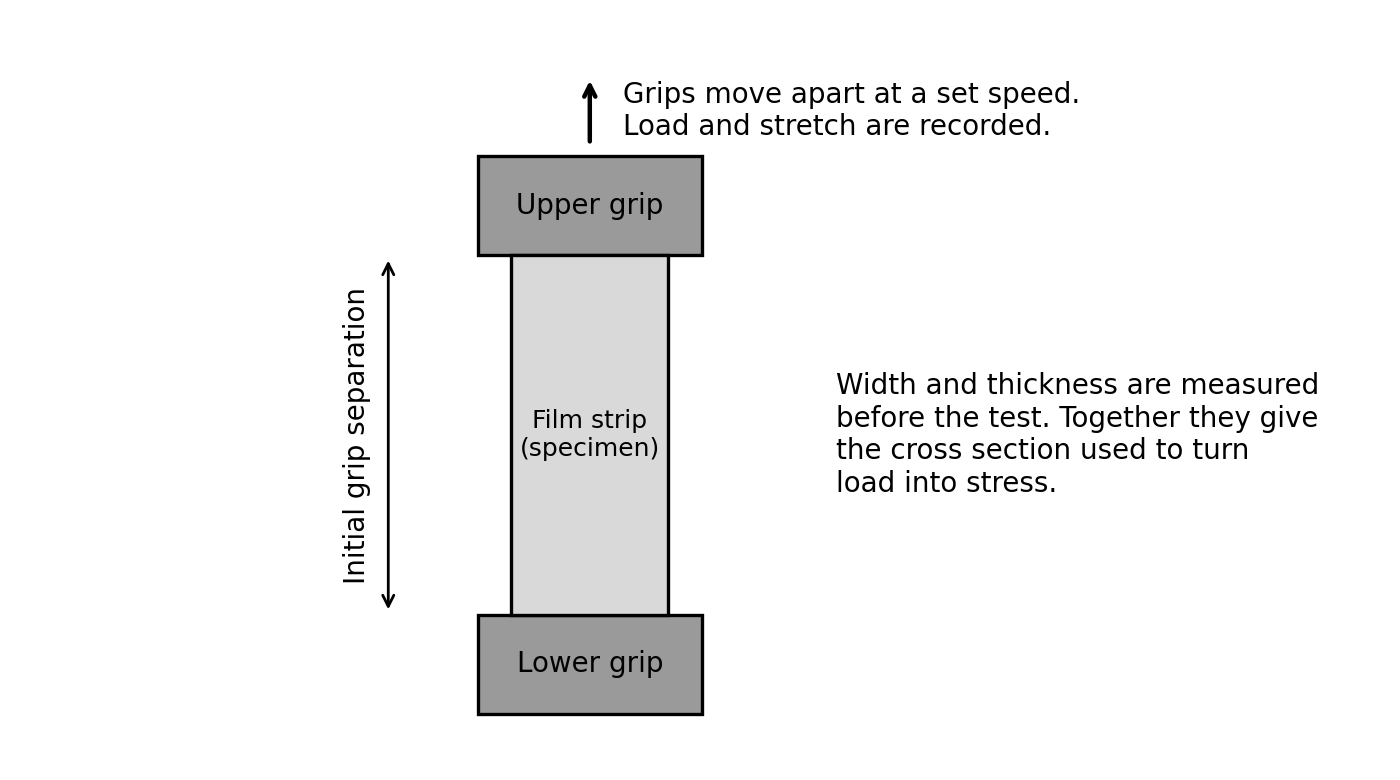
The tester holds a strip of film at both ends. One end stays fixed while the other moves away at a set speed. A load sensor measures the pull on the strip, and the machine records how far the strip stretches. Dividing the load by the starting cross section gives stress, and dividing the stretch by the starting length gives strain.
ASTM D882 allows the stretch to be measured in three ways: by the movement of the grips, by a measuring device attached to the strip, or by marks drawn on the strip [1]. Grip movement is the simplest. In general, though, it also counts any slipping or squeezing of the film inside the grips. A device attached to the strip measures the film itself more directly, and the standard notes that such a device is desirable when stiffness is being measured [1].
Reading the curve
The shape of the curve tells you more than any single number. A stiff, brittle film climbs steeply and breaks after only a little stretch. A tough film may climb, reach a yield region, stretch at nearly constant load, and then stiffen again before it breaks. Some films show no clear yield point at all. Figure 3 shows these behaviors for imaginary films and is not measured data.
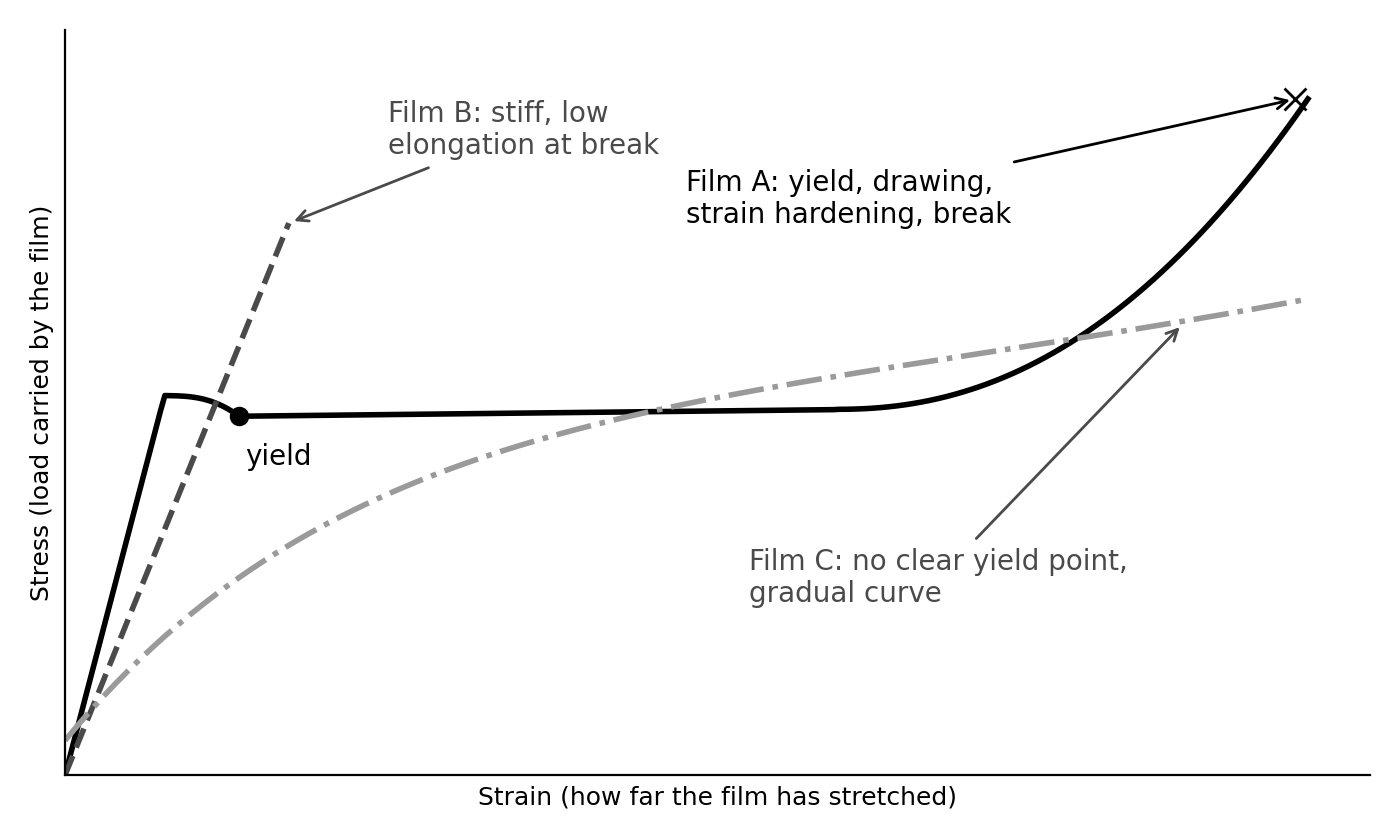
This is why one number can mislead. Two films can have the same strength while one breaks after a few percent of stretch and the other after several hundred percent. During processing and handling that difference can matter a great deal. Keep the full curve with the summary values so that you can investigate problems later.
Main Parts of a Tensile Testing Machine
Designs differ between makers, so this is a general description and does not describe any one machine.
- Load sensor. It turns the pull on the strip into an electrical signal. Its range and fineness should suit the films you test. A sensor built for strong materials may give coarse readings on thin film.
- Drive and frame. A motor moves one grip at a set speed. The distance it can travel limits how far a very stretchy film can be pulled before the test must stop.
- Grips. They hold the strip at each end. ASTM D882 lists the type of grip among the things that affect results [1].
- Stretch measurement. Stretch can come from grip movement, a measuring device on the strip, or marks on the strip [1].
- Control software. It sets the speed, records load and stretch, draws the curve and calculates the results. Report templates help keep records consistent.
- Safety features. Look for travel limits, overload protection and an emergency stop, and confirm what a given model actually provides.
The Test Procedure in Seven Steps
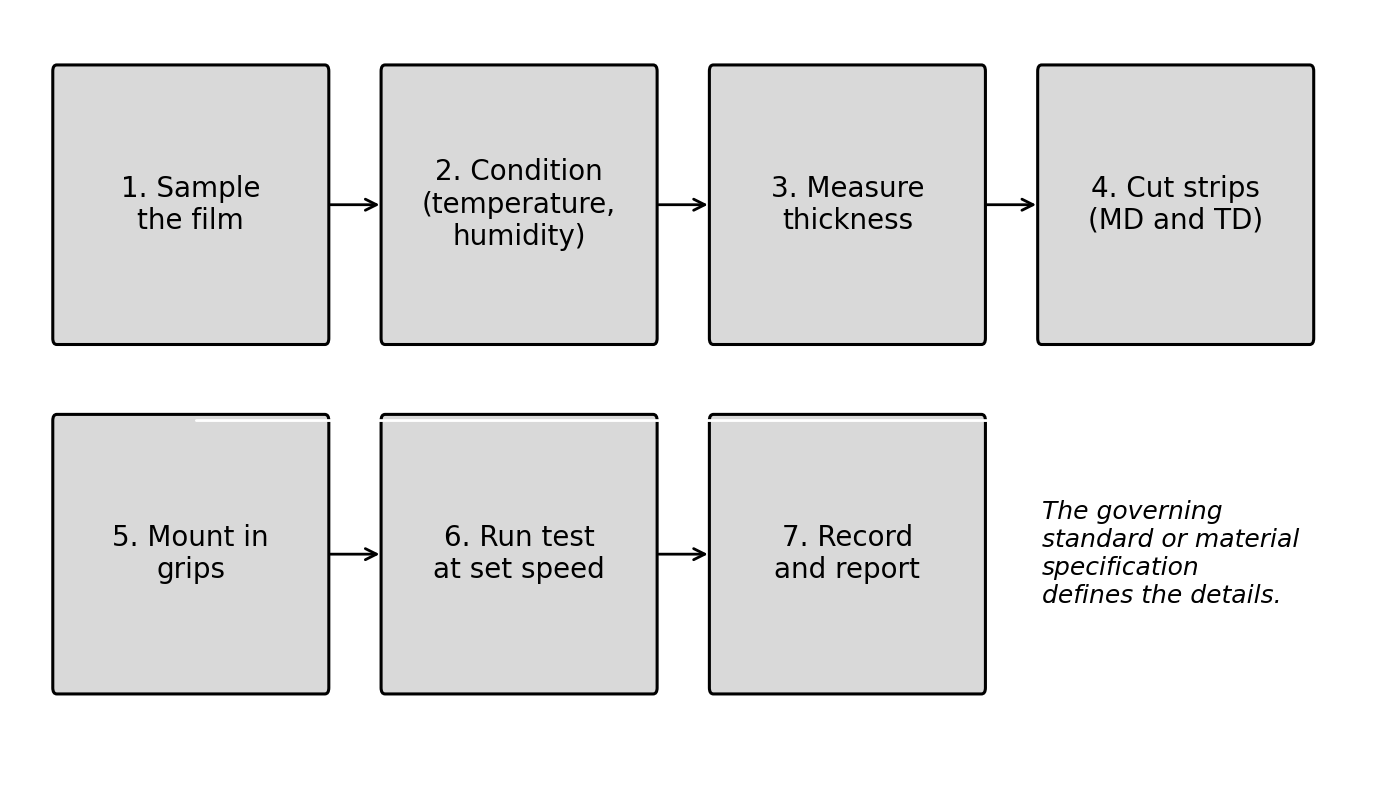
The steps below are a general laboratory routine. The standard or specification you follow sets the strip size, the distance between grips, the test speed and the number of strips. Those values are not given here and must come from the standard.
-
Sampling. Take strips from places that represent the roll or lot. Avoid damaged edges and creases, and record the roll, lot and position. The standard or specification sets how many strips to test.
-
Conditioning. Temperature and humidity change the behavior of plastics, so conditioning before and during the test is standardized to allow fair comparison [4]. ASTM D618 notes that its procedures aim for reproducible results and do not always bring the material to full balance [4].
-
Thickness. Thickness is needed to calculate stress. ISO 4593 is one published method for measuring film thickness by mechanical scanning, and it is not suitable for embossed film [5]. Your test standard or specification states which method and sampling to use.
-
Cutting. Cut strips along the machine direction and the transverse direction, because many films behave differently in each [7]. Nicked or ragged edges can start an early tear, so use a clean cutting method.
-
Mounting. Fit the strip so the pull runs along its length, with no slack and no tension before the test starts. For slippery or very thin films, choose grip faces with care.
-
Testing. Run each strip at the speed the standard requires. ASTM D882 lists test speed among the factors that affect results [1].
-
Recording. Report the standard and edition, film direction, conditioning, speed, thickness, stretch measuring method and every individual result, not only the average.
What Changes the Result
ASTM D882 states that tensile results can change with strip thickness, the way the strip was prepared, test speed, the type of grips and the way stretch is measured. It adds that these must be carefully controlled when precise comparisons are needed [1]. The table links these and related factors to practical controls.
| Factor | Why it matters | Practical control |
|---|---|---|
| Strip thickness | Thickness sets the cross section used to calculate stress, and ASTM lists it as a source of variation [1]. | Measure thickness by a defined method [5] and record it for every strip. |
| How the strip was prepared | ASTM lists this as a factor [1]. In general, nicked edges can cause early failure. | Use one cutting method and inspect the edges. |
| Test speed | ASTM lists this as a factor [1]. | Use the speed in your standard or specification and record it. |
| Type of grips | ASTM lists this as a factor [1]. Slipping or crushing at the grips distorts the readings. | Choose grip faces that suit the film and watch for slipping. |
| Stretch measurement | Grip movement, a device on the strip and marks on the strip can give different values [1]. | Use the same method whenever you compare materials. |
| Conditioning | Temperature and humidity can change results materially [4]. | Condition as specified and keep the room conditions steady. |
| Film direction | Many strength properties differ between the machine direction and the transverse direction [7]. | Test and report both directions. |
| Strip dimensions | ASTM asks for identical strip dimensions when comparing stiffness between materials [1]. | Use the same width and grip distance for every comparison. |
| Load accuracy | Stress and stiffness depend directly on the load reading. | Calibrate and verify the load system [6] and keep records. |
Machine Direction and Transverse Direction
Films are made and processed in rolls, and most strength properties depend on direction. The machine direction (MD) runs along the length of the roll. The transverse direction (TD), also called the cross direction, runs across the width. Values can differ widely between the two [7]. The same source advises finding out where each direction will lie in the finished package when choosing which properties and levels to require [7]. For this reason packaging films are normally tested in both directions.
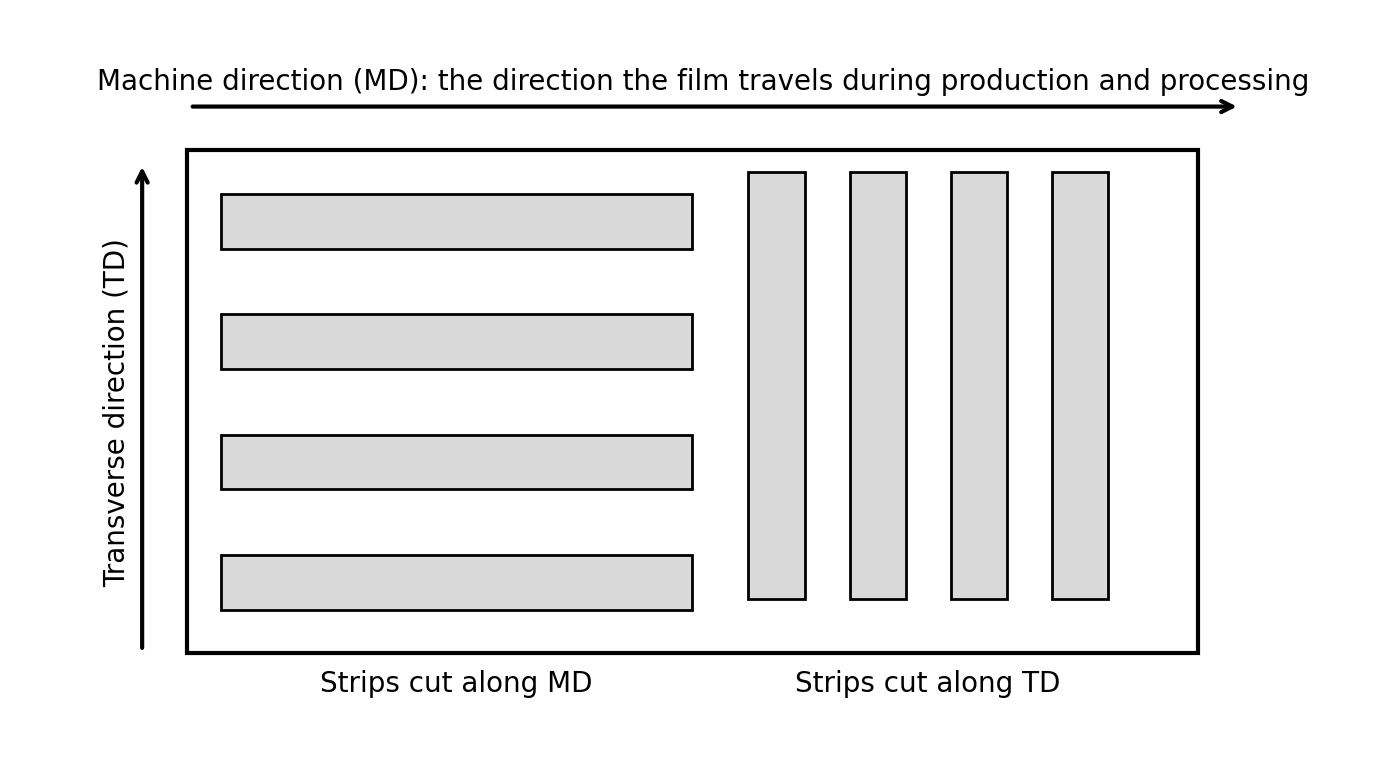
A big gap between MD and TD results is not automatically a defect, because stretched or oriented films are expected to behave differently in each direction. What matters is whether that behavior suits how the film is processed and used, and whether it stays steady from lot to lot.
Where the Results Are Used
Single films and laminates
ASTM D882 notes that thin sheeting and films may be made of several layers, laminations or coatings that cannot be separated [1]. Tensile testing is therefore used on single layer films and on laminates, where the result reflects all the layers working together.
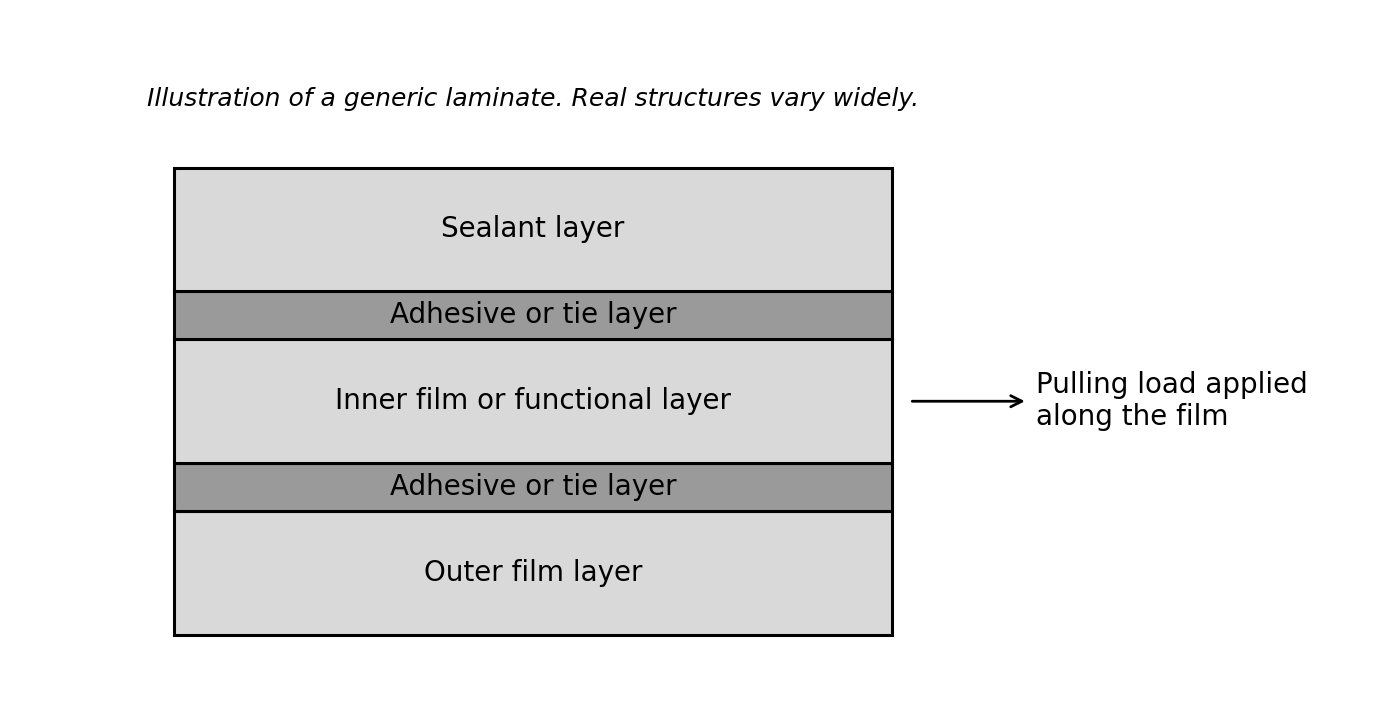
Published studies show tensile data being used alongside other measurements. One study looked at ten multilayer laminates for barrier performance, mechanical properties (tensile strength and elongation at break) and the migration of substances [9]. Another tested six multilayer films for vacuum and modified atmosphere packaging, measuring stiffness, strength, elongation and puncture behavior [10]. A third compared polyethylene and polyamide laminates with a reference polyethylene film, measuring tensile strength, elongation and stiffness together with impact strength [11]. It reported an elongation at break of 689 percent and a tensile strength of 33 N/mm² for one reference film [11]. Those values belong to those films and test conditions and are not typical figures. Laminates can also split into layers during a test, so note any layer separation in the report.
Everyday laboratory uses
- Incoming checks: comparing delivered film with the agreed specification.
- Comparing suppliers or grades. Guidance warns that different test methods can change results, so compare like with like [8].
- Development: seeing how a change of material, layer structure or stretching process shifts strength, stiffness and elongation.
- Failure investigation: testing a failed lot beside a good lot, in both directions and under identical conditions.
Keeping Results Consistent
ASTM D882 observes that results repeat well when every test condition is tightly controlled [1]. This puts the responsibility on the laboratory. Consistency comes from the whole routine: sampling, conditioning, strip preparation, a calibrated load reading and a fixed method. It does not come from the machine alone.
A good record for each result includes the standard and edition, the film and lot, the direction, the conditioning, the strip size and measured thickness, the speed, the stretch measuring method, the machine and its calibration status, and the operator. When results drift, this record lets you tell a change in the material from a change in the method.
Report every individual result and the spread, not only the average, because a wide spread suggests an inconsistent material or method. ASTM also notes that films which fail by tearing give unusual data that cannot be compared with normal failures [1], so note how each strip failed.
Common Problems in Film Tensile Testing
The table lists problems often met in film tensile testing. Where a source supports the cause, the citation is shown. The other entries reflect general laboratory practice and should be checked against the machine manual and your standard.
| Problem | Possible causes | What to do |
|---|---|---|
| Strip slips or tears at the grips | Grip faces that do not suit the film, or too little or too much clamping force. ASTM lists the grip type as a factor [1]. | Choose suitable grip faces and check the clamping. Follow your standard on how to treat slipping or grip breaks. |
| Failure starts at an edge | Nicked or ragged cut edges. Films that fail by tearing give unusual data [1]. | Use a clean cutting method and inspect edges before testing. |
| Large spread between strips | Uneven thickness, inconsistent preparation or different conditioning [1][4]. | Measure thickness [5] and standardize preparation and conditioning. |
| MD and TD results look unexpected | The film itself behaves differently by direction [7], or the strip direction was mixed up. | Mark the direction on every strip and report both directions. |
| Different laboratories report different elongation | Different stretch measuring methods or test speeds [1]. | Agree the method and speed, and report them. |
| The test stops before the film breaks | Not enough grip travel for a very stretchy film. | Check the available travel before testing very stretchy films. |
| Load readings drift | The load system is out of calibration. | Verify the load system at suitable intervals [6]. |
What Tensile Testing Cannot Tell You
Tensile results describe how a strip behaves when it is pulled along its length. A package can fail in other ways. Specification guidance lists tear strength, puncture and impact resistance, heat seal behavior and barrier performance as separate attributes [8]. The table shows how they complement tensile data.
| Property | What it examines | How it relates to tensile data |
|---|---|---|
| Heat seal strength | How strongly the sealed surfaces hold together [8]. | A strong film with a weak seal still fails at the seal. |
| Tear resistance | How easily a tear starts or spreads [8]. | Films with similar strength can tear very differently. |
| Puncture and impact resistance | Resistance to a sharp point or a sudden blow [8][11]. | One study of laminates measured impact separately from tensile strength [11]. |
| Peel and bond strength | How well the layers of a laminate stay stuck together [11]. | A tensile test does not show whether layers separate. |
| Barrier performance | How well the film blocks gases and moisture [9]. | A film can have excellent tensile data and poor barrier performance. |
Some tensile testers can be fitted with extra fixtures for other mechanical tests. The TS-ET2 product page, for example, lists peeling, heat sealing, tearing and puncturing, as well as pharmaceutical package tests such as opening force and puncture force [12]. Whether a machine suits a particular standard method should be confirmed with the supplier and the standard.
How to Choose a Tensile Testing Machine for Flexible Packaging Films
The right machine depends on the films you test, the standards you follow and the data you must report. Use this checklist.
| Question | What to consider |
|---|---|
| Load range and fineness | Match the sensor range to the strength of your films. If accuracy is quoted as a percentage of full scale (the machine's maximum load), the allowed error grows with the range, so ask the supplier for accuracy at the loads your films actually reach. |
| Speed range | Check that the machine covers the speeds your standards and customers require. |
| Travel and grip distance | Very stretchy films need enough travel to reach breaking. One study reported elongation at break of several hundred percent for polyethylene films [11]. |
| Strip width | Check that the grips take the strip widths in your methods. |
| Grips and fixtures | Confirm the grips suit your films and that fixtures exist for any extra tests you plan, such as peel or heat seal strength. |
| Stretch measurement | Decide whether grip movement is good enough or whether a measuring device on the strip is needed, for example when stiffness matters [1]. |
| Software and reports | Look for a live curve display, flexible test setup, the calculations you report, data export and report generation. |
| Calibration | Ask how the load and distance systems are checked and what paperwork comes with them [6]. |
| Safety | Check travel limits, overload protection, an emergency stop and guarding. |
| Support | Consider installation, training, calibration service, spare parts and the quality of the manual. |
Read published specifications carefully. A supplier may say a machine was developed to meet several standards, but you should still confirm that the exact method, strip size and test speed you need are supported. An example of a supplier's published specification appears in the product section after the conclusion [12].
Care, Safety and Good Practice
Follow the machine manual for any instruction specific to your model. The points below apply in general.
- Keep the load system checked and calibrated, and keep the certificates [6].
- Inspect the grip faces and alignment regularly, because grip condition affects results [1].
- Never load the sensor beyond its rated range.
- Use the guards and the emergency stop as designed, and keep hands away from moving parts and grips.
- Remember that the user is responsible for safe, healthy and environmentally sound practice, as ASTM D882 itself states [1].
- Do not borrow service or calibration intervals from another machine. Use those from the maker and your quality system.
Frequently Asked Questions
What is the difference between tensile strength and elongation at break?
Tensile strength relates to how much load the film can carry. Elongation at break is how far the film stretches before it breaks, shown as a percentage of its starting length. A film can be high in one and low in the other.
Why test both the machine and transverse directions?
Strength often differs by direction [7]. Testing both shows whether the film suits the way it will be processed and used.
Can I compare ASTM D882 and ISO 527 Part 3 results directly?
ASTM D882 calls itself technically similar to ISO 527 Part 3 [1], which is not the same as equal. Check the strip type, speed and stretch measuring method before treating the results as interchangeable.
Does film thickness decide which standard to use?
Yes. ASTM D882 covers thin sheeting and film under 1.0 mm and points to ASTM D638 for thicker material [1]. ISO 527 Part 3 covers films and sheets under 1 mm and sends thicker sheet to ISO 527 Part 2 [2].
Why do my results change from run to run?
Thickness, strip preparation, speed, grips and the way stretch is measured can all change the result, and ASTM says they must be carefully controlled for precise comparison [1]. Conditioning matters as well [4].
Is a tensile test enough to approve a flexible packaging film?
No. Tear, puncture, impact, seal strength, bonding between layers and barrier performance are separate attributes [8][9][11]. Tensile data are one part of the picture.
Conclusion
Tensile strength and elongation testing gives packaging laboratories a controlled way to compare films, check incoming material and see the effect of structure and processing. The value of a result depends on the quality of the method. Thickness, strip preparation, speed, grips, stretch measurement, conditioning and load calibration all influence the outcome, so the standard must be followed and every detail recorded.
Read the whole curve and not just the summary numbers. Test both film directions, and combine tensile data with tests for tearing, puncture, seals, layer bonding and barrier performance. When you choose a tensile testing machine, match its load range, travel, speed range and software to the films and standards you actually work with.
Relevant Testshine Product
Tensile and Elongation Testing for Flexible Packaging with the Testshine TS-ET2 Electronic Tensile Tester
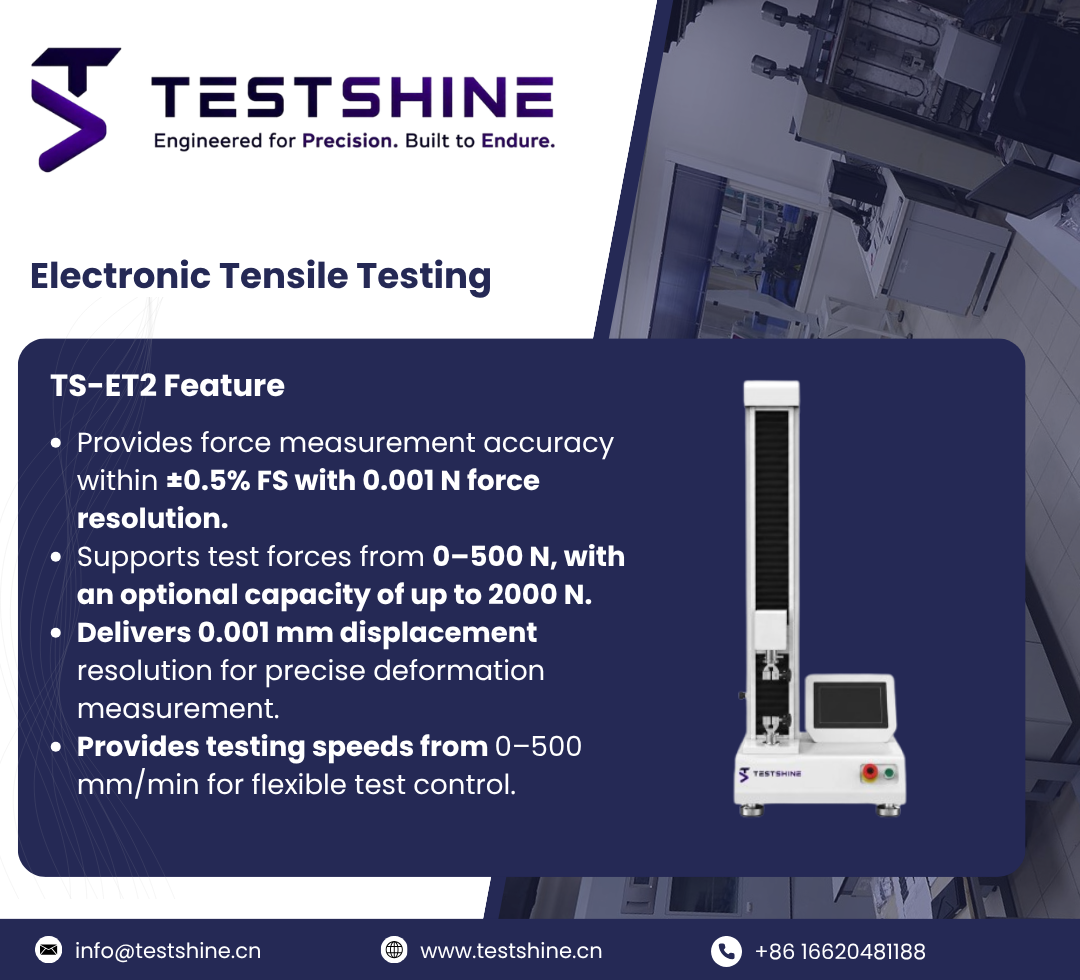
Trustworthy film tensile data need a controlled test speed, an accurate load reading and a clear record of the curve. The Testshine TS-ET2 is a single column electronic tensile testing machine. The Testshine website lists it for tensile, peeling, heat sealing, tearing, puncturing and other tests on plastic films, composite films and flexible packaging materials.
Why it may fit your application:
- Load and speed range. Test force of 0 to 500 N (0 to 2000 N optional) and a test speed of 0 to 500 mm/min that can be set to any value in that range.
- Measurement. Stated test accuracy within ±0.5% FS (percent of full scale), load resolution of 0.001 N and distance resolution of 0.001 mm.
- Data and reports. A color touchscreen shows the test curve as the test runs, and recorded data can be reviewed and reports produced on the machine.
- Safety and options. Travel limit protection, overload protection and an emergency stop are listed, and measuring devices for the strip can be fitted for tests that need them.
Because the stated accuracy is a percentage of full scale, ask the Testshine team whether the machine suits the load levels of your films, and which fixtures, strip width and stretch measuring options are available for the test method you follow.
References
-
ASTM International, “Standard Test Method for Tensile Properties of Thin Plastic Sheeting,” ASTM D882, 2026a edition, West Conshohocken, PA, 2026. Open source page
-
International Organization for Standardization, “Plastics: Determination of tensile properties. Part 3: Test conditions for films and sheets,” ISO 527 Part 3, 2nd edition, Geneva, 2018. Open source page
-
International Organization for Standardization, “Plastics: Determination of tensile properties. Part 1: General principles,” ISO 527 Part 1, 3rd edition, Geneva, 2019. Open source page
-
ASTM International, “Standard Practice for Conditioning Plastics for Testing,” ASTM D618, 2021 edition, West Conshohocken, PA, 2021. Open source page
-
International Organization for Standardization, “Plastics: Film and sheeting. Determination of thickness by mechanical scanning,” ISO 4593, 2nd edition, Geneva, 1993. Open source page
-
International Organization for Standardization, “Metallic materials: Calibration and verification of static uniaxial testing machines. Part 1: Tension/compression testing machines. Calibration and verification of the force measuring system,” ISO 7500 Part 1, 5th edition, Geneva, 2018. Open source page
-
PMMI ProSource, “Detailed properties and attributes for film structures,” Flexible Packaging Playbook (online). Open source page
-
Packaging World (PMMI), “Measuring commonly specified film attributes,” Flexible Packaging Playbook (online). Open source page
-
S. Ibrahim and M. Abdellatif, “Multilayer Flexible Packaging Materials: Relationship between Structure and Functional Properties,” Egyptian Journal of Chemistry, vol. 62, no. 10, pages 1963 to 1969, 2019. Open source page
-
A. Wójtowicz, “Selected Properties of Multilayer Films Applied for Vacuum and Modified Atmosphere Packaging Systems,” Agricultural Engineering, vol. 22, no. 4, pages 89 to 98, 2018. Open source page
-
B. Krisnamurti, H. Irawati, M. A. E. Hafizah and A. Manaf, “Analyzing Impact Strength Improvement in Polymer Laminates” (title shortened here, the full title continues with a comparative study of two laminate structures), Trends in Sciences, vol. 21, no. 7, article 7723, 2024. Open source page
-
Testshine Co., Ltd., “Electronic Tensile Tester TS-ET2,” product page, accessed 31 October 2026. Open source page
Related Posts

Mechanical and Seal Integrity Testing for Flexible Packaging: A Guide to Quality Assurance

Heat Seal Strength Testing: Ensuring Reliable Seals in Flexible Packaging

Flexible Packaging Quality Control: Essential Testing Methods and Standards

Coefficient of Friction Testing for Flexible Packaging: Why Surface Friction Matters
Mechanical and Seal Integrity Testing for Flexible Packaging: A Guide to Quality Assurance
Heat Seal Strength Testing: Ensuring Reliable Seals in Flexible Packaging
Flexible Packaging Quality Control: Essential Testing Methods and Standards