Differential Scanning Calorimeter
Differential Scanning Calorimeter
 1 / 4
1 / 4Differential Scanning Calorimeter
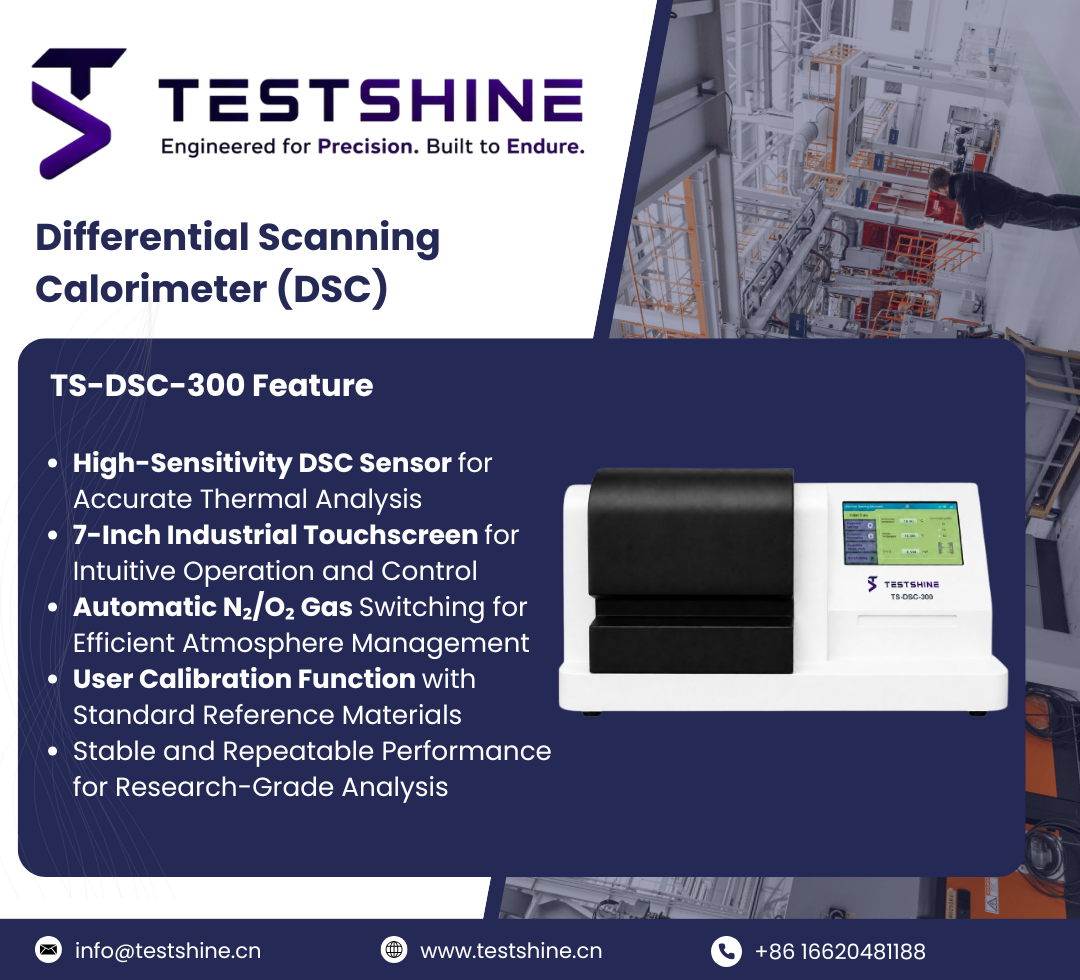
The TS-DSC-300C is a high-precision thermal analysis instrument designed to accurately measure heat flow associated with physical and chemical transitions in materials. Built for advanced research, product development, and quality assurance, it delivers reliable thermal characterization across polymers, plastics, pharmaceuticals, chemicals, composites, and adhesives.
Key Specifications
Temperature Range
RT–600°C
Heating Rate
0.1–100°C/min
DSC Sensitivity
0.001 mW
Gas Control
Auto N₂/O₂ Switching
Global Shipping
50+ countries
2-Year Warranty
Parts & service
Expert Support
Dedicated team
Have a question about this instrument?
Talk to an expertProduct Introduction
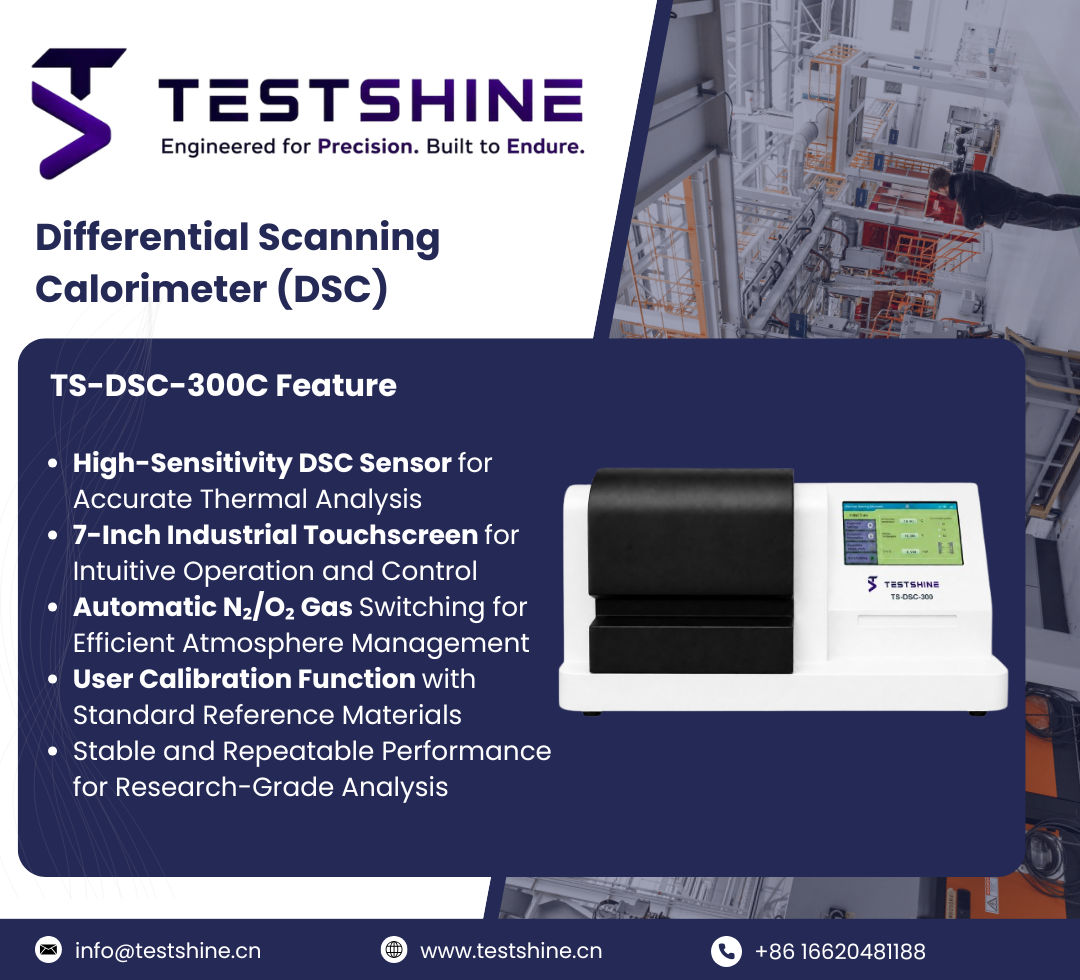
TS-DSC-300C Differential Scanning Calorimeter is a high-performance thermal analysis instrument designed to provide precise and reliable characterization of material thermal properties. As one of the most advanced models in the DSC series, the TS-DSC-300C combines superior measurement accuracy with excellent sensitivity and repeatability, making it an ideal solution for research, quality control, product development, and material evaluation applications.
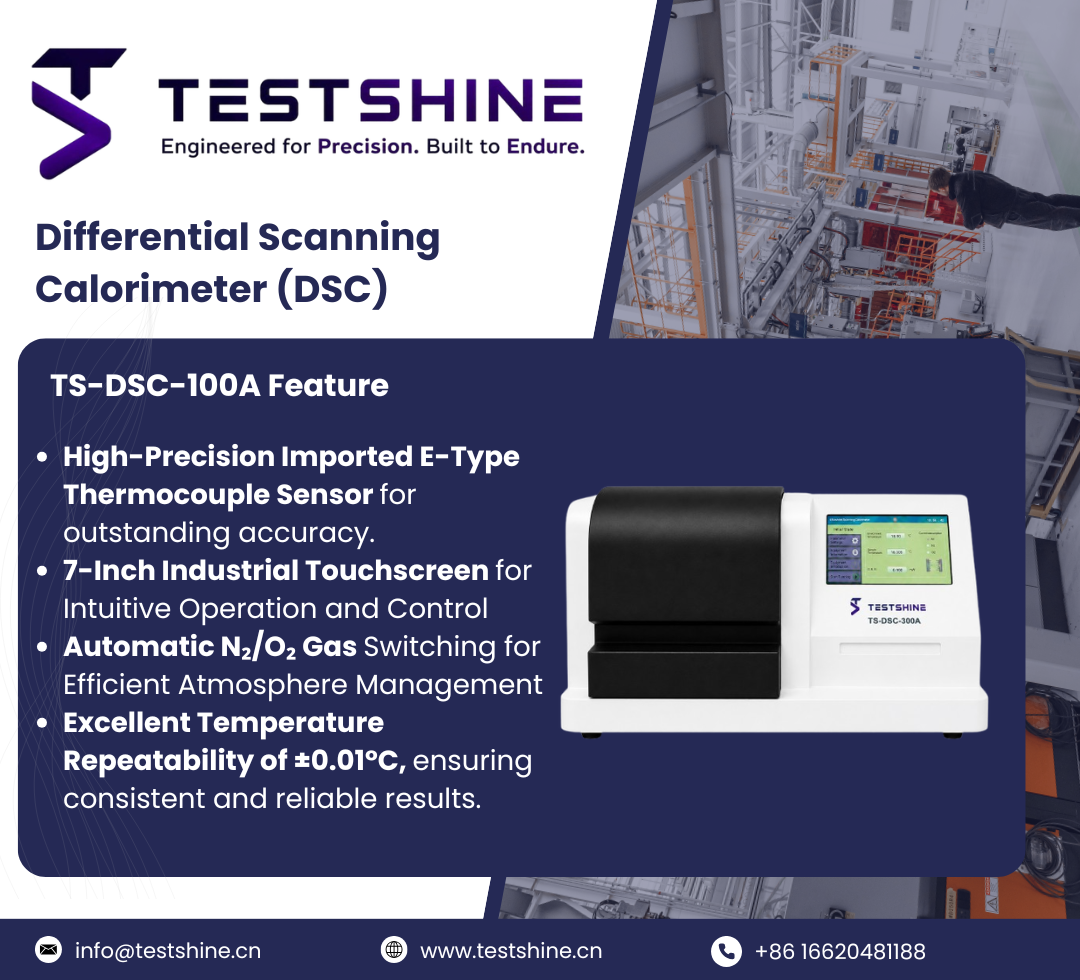
At the core of the instrument is an imported E-pair sensor, engineered to deliver exceptional thermal response and long-term measurement stability. The advanced sensor technology enables accurate detection of subtle thermal events, while the optimized signal acquisition circuit incorporates shielding protection to minimize external interference and ensure outstanding baseline stability. This robust design guarantees highly consistent and reproducible test results, even during demanding analytical procedures.
With its combination of precision, reliability, and user-friendly operation, the TS-DSC-300C provides an efficient and dependable platform for thermal characterization, helping organizations improve product quality, optimize manufacturing processes, and accelerate innovation across diverse application fields.
Key Features
- Imported E-Pair Sensor for high accuracy, sensitivity, and repeatability.
- Precise Thermal Transition Analysis for Tg, melting point, and phase transition studies.
- Advanced Shielding Protection for strong anti-interference performance.
- Industrial 7-inch Color Touchscreen Display for intuitive operation and real-time monitoring.
- Excellent Baseline Stability for reliable and consistent test results.
Technical Parameters
| Instrument Type | Differential Scanning Calorimeter (TS-DSC) |
| Temperature Range | -40°C to 600°C |
| Temperature Resolution | 0.001°C |
| Temperature Fluctuation | ±0.01°C |
| Temperature Repeatability | ±0.01°C |
| Heating Rate | 0.1 to 100°C/min |
| Isothermal Holding Time | Programmable, up to 24 hours |
| Temperature Control Mode | Automatic program control for heating, isothermal holding, and cooling |
| DSC Measurement Range | 0 to ±800 mW |
| DSC Resolution | 0.01 μW |
| DSC Sensitivity | 0.001 mW |
| Power Supply | AC 220V, 50Hz (customized options available) |
| Atmosphere Control Gas | Nitrogen (N₂), Oxygen (O₂) with automatic program-controlled switching |
| Gas Flow Rate | 0–200 mL/min |
| Gas Pressure | ≤ 0.5 MPa |
| Display | 7-inch LCD Touchscreen, 24-bit Color Display |
| Calibration Standard | Supplied with certified reference materials (Indium and Tin) for user temperature calibration |
| Data Interface | Standard USB Interface |
| Temperature Monitoring System | Multiple thermocouple configuration for sample temperature, furnace temperature, and internal ambient temperature measurement |
| Temperature Range | -40°C to 600°C |
| Temperature Resolution | 0.001°C |
Applications
Polymer & Plastics Industry
The TS-DSC-300C is extensively used to characterize polymers and plastics by evaluating glass transition temperature, melting point, crystallization behavior, oxidation resistance, and thermal stability. These measurements help manufacturers optimize formulations, verify material consistency, assess additive performance, and ensure product quality throughout the development and production process.
Rubber & Elastomer Testing
The TS-DSC-300C provides detailed insight into thermal transitions, curing characteristics, oxidation resistance, and material stability for rubber and elastomer applications. It is commonly used to evaluate natural rubber, synthetic rubber, elastomer blends, and specialty compounds used in automotive, industrial, consumer, and engineering applications. Through precise thermal analysis, manufacturers can investigate curing reactions, determine glass transition temperatures, assess formulation performance, and study the effects of fillers, plasticizers, stabilizers, and other additives.
Chemicals, Resins & Adhesives
The TS-DSC-300C is an effective analytical tool for the characterization of chemicals, resins, and adhesive materials, providing critical information on phase transitions, curing behavior, reaction kinetics, thermal stability, and enthalpy changes. It is widely used to evaluate epoxy resins, acrylic systems, thermosetting materials, sealants, coatings, and industrial adhesives throughout research, development, and manufacturing processes. By monitoring curing temperatures and reaction profiles, users can optimize formulations, improve processing conditions, verify product performance, and ensure quality consistency.
Composites & Advanced Materials
The TS-DSC-300C delivers accurate thermal analysis data that supports material development, performance validation, and quality control for composites and advanced materials. The instrument is used to study polymer-matrix composites, reinforced materials, specialty coatings, high-performance engineering materials, and other advanced formulations. Thermal measurements such as glass transition temperature, curing behavior, crystallization, and thermal stability help researchers understand material structure-property relationships and optimize processing parameters.
Academic Research & Testing Laboratories
The TS-DSC-300C is widely utilized by universities, research institutions, and independent testing laboratories for both routine and advanced thermal analysis applications. Its high accuracy, sensitivity, repeatability, and stable performance make it suitable for material characterization, comparative studies, method development, and quality assessment across a wide variety of sample types. Researchers use the instrument to investigate thermal transitions, phase behavior, crystallization processes, curing reactions, and material stability, while testing laboratories rely on its dependable results for analytical services, material verification, and quality evaluation.