
Flexible Packaging Quality Control: Essential Testing Methods and Standards
A flexible package has many jobs. Films, laminates, pouches, bags and lidding materials must survive filling and shipping, close reliably, open the way the designer intended, run smoothly on packaging machines and, in many cases, keep moisture and gases out. Quality control turns these needs into numbers that a film supplier, a converter and a brand owner can all agree on.
This article walks through the main physical tests used for flexible packaging: film tensile testing, seal strength, laminate bond strength, tear resistance, puncture resistance, friction, barrier testing and leak detection. For each one it explains what is measured, which published standard describes the method and what most affects the result. It then covers other useful measurements, sample preparation, repeatability, common mistakes and how to choose a tensile tester for a packaging laboratory.
This is general guidance, not a replacement for the standards. It draws on the public scope and summary text of each standard and on published research. The editions named were the current ones we could identify at the time of writing. Before you write a laboratory method or a supply specification, get the current edition of the standard and follow it, because sample sizes, test speeds and reporting rules are set there.
Key takeaways
- Sort tests by what they examine: the film, the seals and bonds, the barrier, and the finished pack. Each group needs different equipment.
- Seal strength is a force reading. It does not prove a seal is continuous or leak free, so pair it with a leak or continuity test [3][4][11].
- Sample preparation, thickness, test speed, grips and conditioning can change results as much as the material does [1][3][6][7].
- Do not treat ASTM and ISO methods as interchangeable until you have compared them [1][2][6].
- One electronic tensile tester can handle film tensile, seal peel and laminate peel work with the right fixtures. Pendulum tear, barrier and leak tests need other instruments [7][9][10][11].
Why Flexible Packaging Needs a Structured Testing Program
Flexible packages tend to fail in familiar ways. A seal opens during shipping, or it is so strong that a shopper cannot open the pack. A film tears or is pierced by a sharp product. The layers of a laminate come apart after filling. A film is too slippery or too sticky for the packaging line. A barrier layer lets in too much water vapor or oxygen. Each of these problems has at least one standard test that measures the property behind it.
Testing also helps you control the process, not just accept or reject lots. ASTM F88/F88M describes seal strength as a measurable value for validating, controlling and judging a sealing process [3]. ASTM D882 says tensile properties help identify and describe materials for control and specification, as well as for research and design [1]. The same measurements can therefore support incoming checks, production monitoring and new product work.
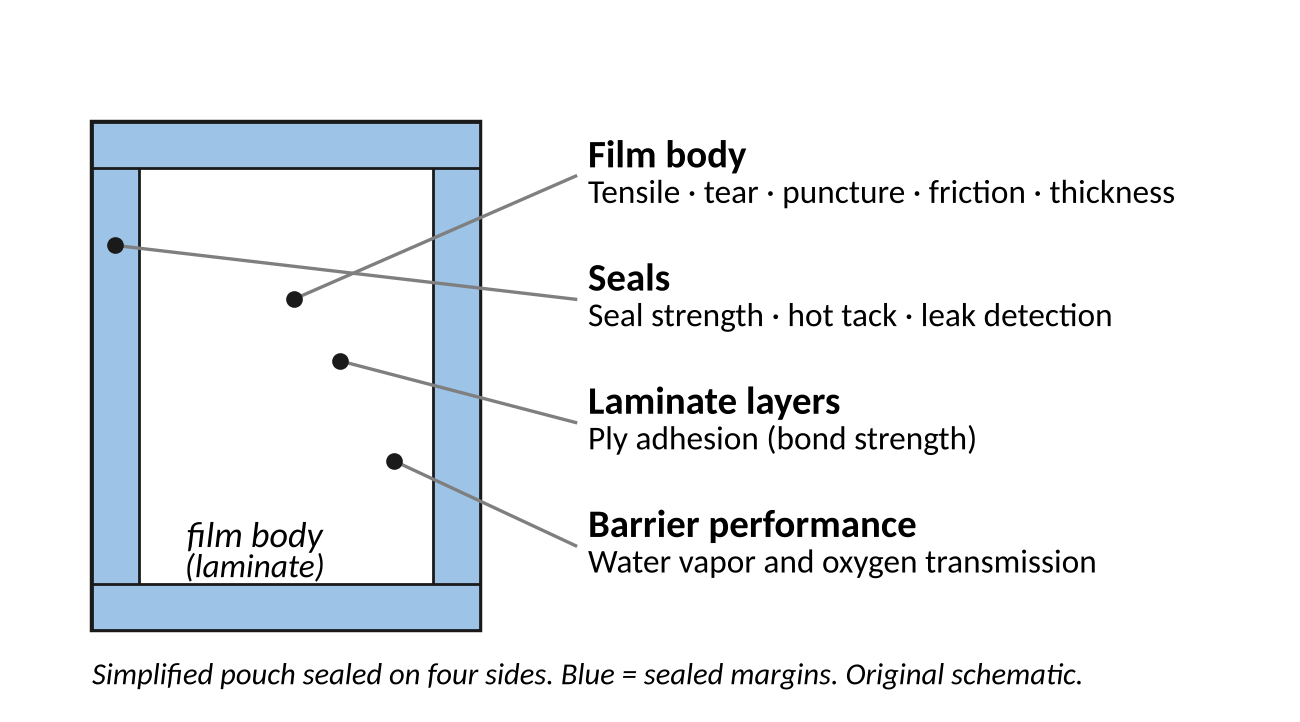
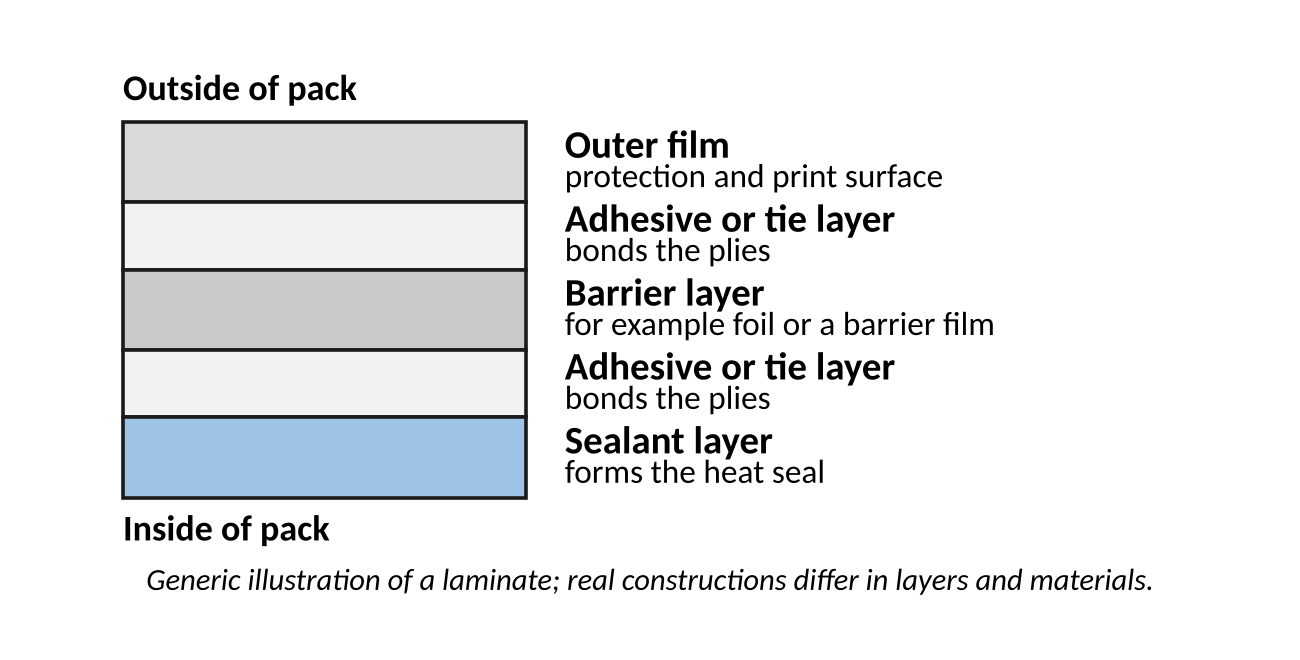
Table 1 lists the tests covered here and the standards behind them. Figure 1 shows which part of a pouch each group of tests looks at.
| Test | What it measures | Example standard |
|---|---|---|
| Tensile properties of film | Strength, stretch and stiffness of thin film pulled in tension | ASTM D882 [1]; ISO 527 Part 3 [2] |
| Seal strength | Force needed to pull apart a strip containing a seal, and how it failed | ASTM F88/F88M [3] |
| Laboratory heat seals | Making heat seals to judge how well a material seals | ASTM F2029 [4] |
| Ply separation for bond strength | Separating the layers of a laminate so bond strength can be measured | ASTM F904 [8] |
| Tear resistance | Average force to keep a tear going, measured with a pendulum | ASTM D1922 [7] |
| Slow rate penetration | Force, energy and probe travel until the film is pierced | ASTM F1306 [5] |
| Coefficient of friction | How easily film starts to slide and keeps sliding | ASTM D1894 [6] |
| Water vapor transmission | How fast water vapor passes through film or sheet | ASTM F1249 [9] |
| Oxygen transmission | How fast oxygen passes through film and laminates | ASTM D3985 [10] |
| Leak detection | Finding leaks in a pack without damaging it, using vacuum decay | ASTM F2338 [11] |
Table 1. Common flexible packaging tests and the standards that define them
Tensile Testing of Plastic Film (ASTM D882 and ISO 527 Part 3)
Tensile testing is the most general mechanical test in a film laboratory. The grips, load cell and software used for it are also used in several of the tests that follow.
What the test measures
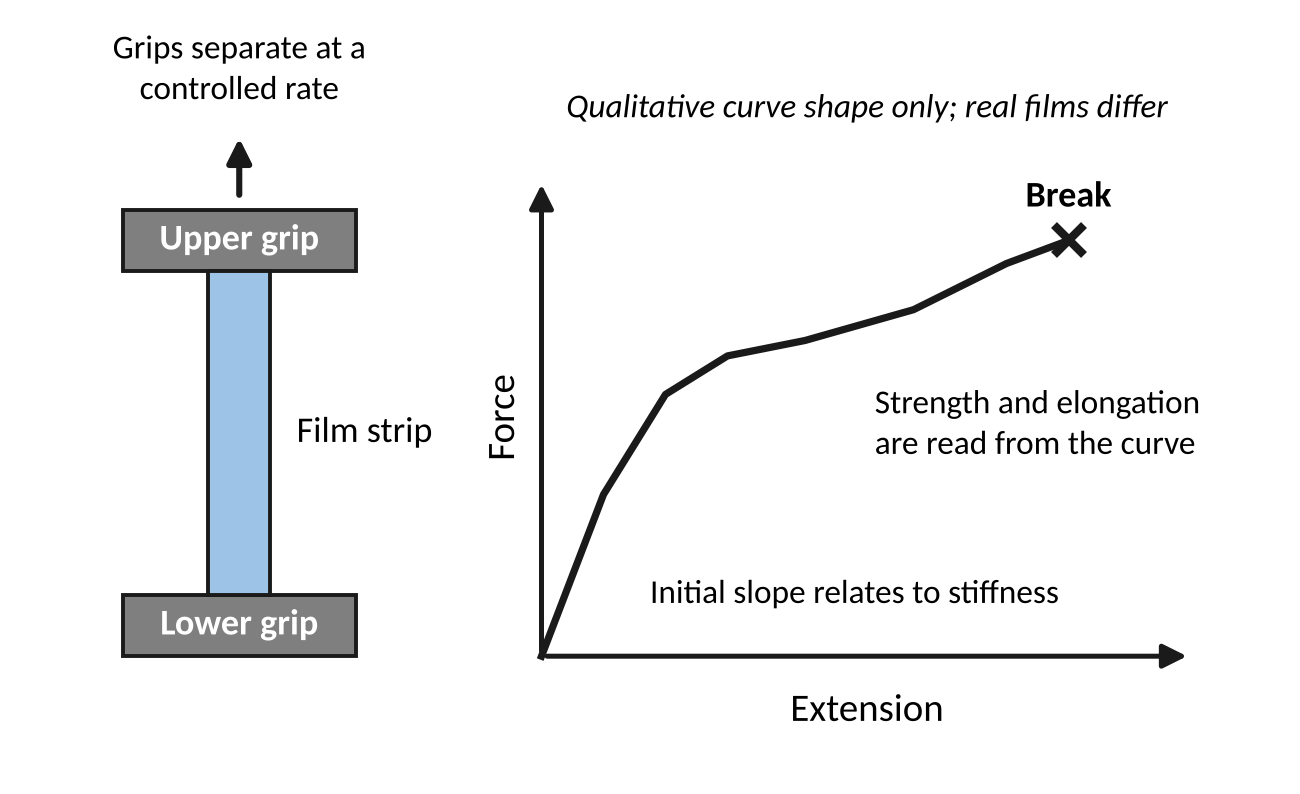
A strip of film is held between two grips. The grips move apart at a set speed while the machine records force and stretch until the strip breaks. From that record a laboratory can report tensile strength, elongation and modulus, which is a measure of stiffness. ASTM D882 covers thin plastic sheet, including film, under 1.0 mm thick. It allows stretch to be measured from grip movement, with an extension gauge, or from marks on the specimen [1]. It describes tensile modulus as an index of how stiff thin plastic sheet is [1].
These properties answer practical questions. Stiffness affects how a film feeds and tracks on a machine. Strength and elongation at break show how much load a film can carry before it fails. Oriented films can behave differently in different directions, so always record the direction in which each specimen was cut. Tear resistance in particular can differ strongly by direction [7].
Choosing between the two standards
Two standards dominate film tensile testing. ASTM D882 is the ASTM method for thin plastic sheet, and its 2026 edition is listed as active at the time of writing [1]. ISO 527 Part 3 (2018 edition) sets the test conditions for films and sheets under 1 mm thick and builds on the general rules in ISO 527 Part 1. For thicker sheets it points to ISO 527 Part 2 [2]. It is not normally suitable for cellular materials or for plastics reinforced with textile fibers [2]. ASTM D882 points to ASTM D638 for plastics 1.0 mm thick or more [1].
The 2026 edition of ASTM D882 calls itself technically similar to ISO 527 Part 3 [1]. Similar does not mean identical. Before you swap results from one standard for the other, compare the specimen shape, test speed and the way stretch is measured in both documents.
What changes tensile results
ASTM D882 says tensile properties can vary with specimen thickness, how the specimen was prepared, test speed, grip type and how stretch is measured [1]. It also warns that materials that fail by tearing give unusual data that cannot be compared with data from a normal break [1]. In practice:
- Cut specimens cleanly. Damage at the edge of a thin film can start a tear, and a torn specimen gives unusual data [1].
- Measure and report thickness, because property values can change with it [1].
- Keep the grip type, test speed and stretch measurement method the same across a set of results, and write them down [1].
- Do not compare results from materials that failed in different ways, such as a clean break and a tear [1].
Tensile testing describes the body of the film. Next come the seals, which are usually the weakest area of a pouch.
Seal Strength Testing: Heat Seal Peel Tests (ASTM F88/F88M)
What ASTM F88/F88M covers
ASTM F88/F88M is the widely used method for the seal strength of flexible barrier materials. It measures the force needed to pull apart a strip that contains a seal, and it records how the specimen failed. The seal can join two flexible materials or a flexible material and a rigid one [3]. The 2023 edition is listed as current at the time of writing [3].
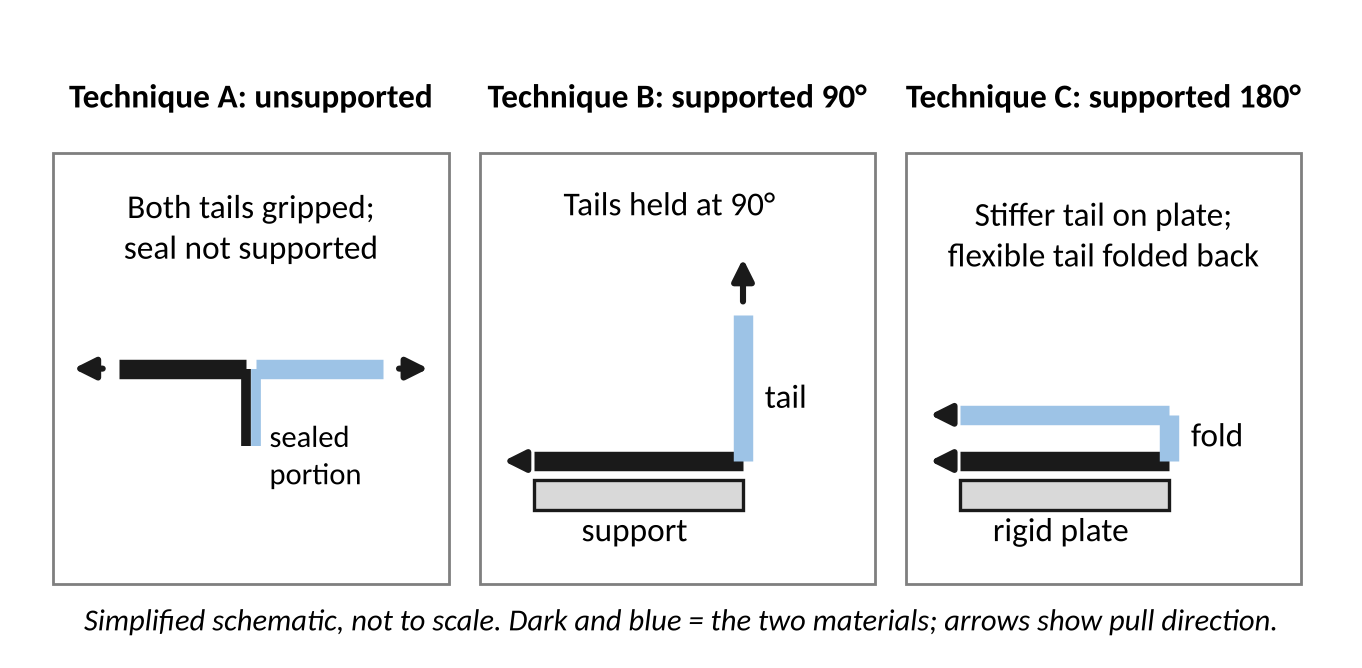
The force you read is not always seal strength alone. The standard notes that part of it may come from bending, and it describes three ways of handling the loose ends, called tails, of the specimen [3]:
- Technique A, unsupported: each tail is held in its own grip and nothing supports the seal during the test.
- Technique B, supported at 90 degrees: the seal is supported at a right angle to the tails during the test.
- Technique C, supported at 180 degrees: for seals between two flexible materials, the stiffer tail is held flat against a rigid plate and the more flexible tail is folded back over the seal.
Each technique loads the seal differently, so use the same one for a whole test series [3]. The standard also notes that some materials may move or flip their tail during the test. Report this with the result [3].
Reading seal strength and failure mode
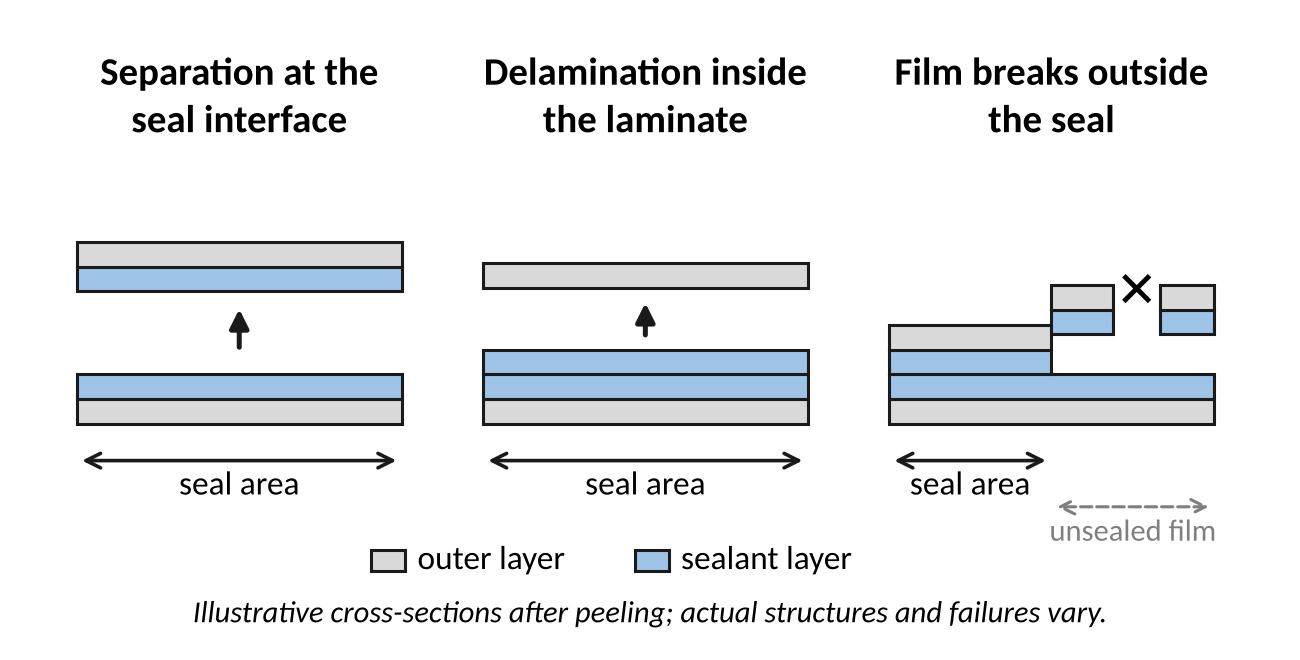
One peak force does not describe a seal. The value can also reflect the properties of the materials themselves, because they may stretch or deform during the test [3]. How the seal failed adds useful information, which is why the method asks the laboratory to record the failure mode [3]. Three outcomes are common: the seal opens at its own surface, a layer inside the laminate separates, or the film breaks outside the seal. Each points to a different place to look, such as the sealing settings, the laminate bond or the film strength. The standard itself does not prescribe fixes.
Acceptance limits depend on the pack. Lower limits typically give confidence that the pack is closed. Upper limits typically apply to peelable seals, where the force needed to open the pack matters [3].
Making laboratory heat seals (ASTM F2029)
When you want to learn how a sealant layer behaves, rather than test seals from a production line, ASTM F2029 describes how to make heat seals in the laboratory and how to treat the seal strength data to judge sealability [4]. It applies only to hot bar or impulse sealers, uses seal strength measured by ASTM F88/F88M as its only measure, and does not cover whether a seal is continuous [4]. It also notes that a laboratory sealer differs from factory equipment in size, sealing area and speed. Laboratory results are therefore a starting point for production settings, not a replacement for validating them [4]. ASTM has had a revision of this standard under review since April 2025, so check which edition is current before you cite it.
The roles are separate. A heat seal tester makes the seals under controlled temperature, pressure and time. A tensile tester then measures the force needed to peel them apart.
Published research supports recording your sealing conditions. A 2022 study of paper based flexible materials on a vertical packaging machine reviews earlier work showing that sealing temperature and dwell time strongly affect seal strength, and it stresses that every material needs its own sealing conditions [13]. Record temperature, dwell time and pressure next to every seal strength result.
Seal strength is not the same as seal integrity
A seal can have good peel strength and still leak through a channel or a gap caused by contamination. ASTM F2029 states that seal continuity is outside its scope [4]. Leak detection, covered later, adds to seal strength testing and does not replace it.
Laminate Bond Strength (Ply Adhesion)
Many barrier structures are laminates of paper, film and foil, and they work only if the layers stay together. When layers separate (delamination), a barrier layer can be exposed, the pack can look different, or a seal can fail from the inside. ASTM F88/F88M refers readers to a separate standard for the bond strength of flexible laminates [3]. That standard is ASTM F904. Its active 2022 edition is titled as a standard practice for separating the plies of laminated flexible materials so that bond strength can be measured [8]. It describes how to separate the plies. The force itself is measured on a tensile tester with suitable fixtures.
Earlier editions of F904 warned that bending of the separated plies means results for different materials, or for the same material at different thicknesses, cannot be compared directly [8]. The same caution applies to seal peel tests: compare like with like, and record how each specimen was built and how thick it is.
For bonded assemblies made of two flexible layers, ISO 11339 (2022 edition) describes a T peel test, in which the two layers are pulled apart in opposite directions [15]. It is an adhesives standard, so check its scope against your laminate before you use it.
Tear Resistance Testing (ASTM D1922)
Tear behavior affects how easily a pack opens, how far a damaged film tears during handling and how a film cuts on a machine. ASTM D1922 measures the average force needed to keep a tear going through a set length of plastic film or flexible sheet once the tear has been started. It uses a pendulum tear tester of the Elmendorf type [7]. This is a pendulum test, run on a different instrument from a tensile tester, such as a dedicated Elmendorf tear tester. Tear tests run on a tensile tester are different methods and should not be reported as ASTM D1922 results.
The standard is open about its limits. Oriented films often tear very differently in different directions, and some films stretch a lot while tearing. Between sets of specimens, results can agree to within about 5 % of the average for some films and only to about 50 % for others [7]. Results from specimens of different thickness are usually not comparable [7]. The standard notes that it is equivalent to ISO 6383 Part 2 [7].
Puncture and Penetration Resistance (ASTM F1306)
Sharp edged products, bones, corners and fasteners can pierce a thin barrier film. ASTM F1306 measures how well flexible barrier films and laminates resist a slowly driven probe. The test runs at room temperature, stretches the film in two directions at one fixed speed until it is pierced, and reports the force, the energy and how far the probe traveled before failure [5]. The 2021 edition, reapproved in 2025, is the most recent listed at the time of writing [5].
The response depends on film thickness, stiffness, speed, temperature and the shape and type of probe, so use the standard conditions when you compare materials [5]. Results from different probes or sample holders cannot be compared directly.
Coefficient of Friction (ASTM D1894)
Friction decides how films slide over forming tubes and over each other. ASTM D1894 measures the starting and sliding friction of plastic film and sheet moving over itself or over other surfaces under set conditions [6]. Its 2024 edition is listed as active at the time of writing [6]. A dedicated coefficient of friction tester is one way to run this test.
Friction values depend on the surface, and surfaces change. Slip additives in films such as polyethylene can move to the surface over time, and because this may not happen evenly, repeatability can suffer. The standard adds that results can be sensitive to the age of the film and the condition of its surface [6]. It also states that the method is not equivalent to ISO 8295, so results from the two should not be compared directly [6]. For routine quality control, record the age of the sample and test each product at a consistent time after production.
Barrier Testing: Water Vapor and Oxygen Transmission
Barrier tests use permeation instruments, not a tensile tester. They still belong in any packaging quality plan, because shelf life often depends on them.
ASTM F1249 measures how fast water vapor passes through flexible barrier materials, including plastic film and sheet, using an infrared sensor [9]. The standard describes this rate as an important property that can often be linked directly to shelf life and product stability [9]. It also advises caution when using the permeance and permeability values the method can produce [9]. A water vapor permeability analyzer that uses the infrared method is one type of instrument for this measurement.
ASTM D3985 measures how fast oxygen passes through plastics in the form of film, sheet, laminates, coextrusions and plastic coated papers or fabrics, using a coulometric sensor [10]. Earlier editions of the standard cautioned that oxygen transmission rate is an important factor in how well a barrier protects a product, but not the only one, and that experience based testing is needed to link packaging performance to the measured rate [10]. A coulometric oxygen permeability analyzer is one type of instrument for this measurement.
Package Integrity and Leak Detection
Leak tests look at the finished pack. ASTM F2338 describes how to find leaks in packages without damaging them, using the vacuum decay method. The test detects a pressure change in a test chamber caused by gas or vapor escaping from a pack under vacuum. It needs no dyes or tracer gases and gives a pass or fail answer based on readings from packs known to be leak free [11]. A vacuum decay leak detection tester applies this principle.
Seal strength and leak tightness answer different questions. A strong seal can still leak, and a weak seal may not leak at the moment of the test. A balanced program pairs a force test such as ASTM F88/F88M [3] with a continuity or leak test [4][11].
Other Measurements in a Complete Quality Plan
The tests above form the core of a flexible packaging laboratory, but a complete plan usually adds a few more. Testshine lists instruments for several of them in its packaging testing range. Choose the applicable standard for each one against your own specification.
- Thickness. Almost every comparison in this article depends on thickness [1][7]. An electronic thickness tester is one option.
- Hot tack. Hot tack describes how a seal behaves while it is still hot, before it cools. ASTM F2029 names ASTM F1921 as the standard that covers it [4]. A hot tack tester is listed for this purpose.
- Falling dart impact. This test looks at how well a film resists impact. Testshine lists a falling dart impact tester.
- Burst and seal pressure. Testshine lists an intelligent sealing performance tester for burst and leak work on packages.
- Heat shrinkage. For shrink films, Testshine lists a film heat shrinkage tester.
Migration and food contact rules are also part of quality, but they depend on regional regulations and are outside the scope of this article.
Specimen Preparation, Conditioning and Repeatability
The same film can give different numbers in two laboratories because of how it was prepared, not because of the film. The standards cited here keep returning to the same points: thickness, how specimens are cut, test speed, grips and fixtures, surface condition and how the specimen is held [1][3][6][7].
Conditioning matters too. ISO 291 sets out how to condition and test plastics under constant standard atmospheres [12], and ASTM E171/E171M covers conditioning and testing of flexible barrier packaging [14]. Use the atmosphere named in the test method or your customer specification, and record it. This article gives no temperature or humidity values. Take them from the standards.
| Variable | Why it matters | Evidence |
|---|---|---|
| Specimen thickness | Tensile properties and tear force change with thickness, so results from different thicknesses are often not comparable | [1][7] |
| Specimen preparation | How a specimen is prepared influences tensile properties | [1] |
| Test speed | Affects tensile results; penetration results depend on probe speed | [1][5] |
| Grips and fixtures | Grip type affects tensile results; peel techniques load the seal differently | [1][3] |
| Stretch measurement | Grip movement, extension gauges and marks on the specimen are different ways to measure stretch | [1] |
| Seal conditions | Temperature and dwell time strongly affect seal strength; laboratory seals differ from production seals | [4][13] |
| Surface age | Slip additives move to the surface over time, so friction results change | [6] |
| Film direction | Tear resistance can differ strongly by direction | [7] |
| Conditioning atmosphere | Standard atmospheres make conditioning comparable | [12][14] |
Table 2. Variables that commonly affect flexible packaging test results
Repeatability means getting close results when the same person repeats a test on the same instrument and material. Reproducibility means getting close results in different laboratories or on different sets of specimens. Neither should be assumed. The range quoted in ASTM D1922, about 5 % to 50 % of the average depending on the film, shows how much this can vary between materials even when the standard is followed [7]. Work out repeatability for your own materials and instruments, for example by repeating tests on kept reference samples. Do not apply a standard's precision figures to a different material.
A useful test record includes the standard and edition, the instrument and its calibration status, the specimen ID and thickness, the test direction, the conditioning, the test speed, the grip or fixture type, the peel technique [3] and any unusual behavior such as tail movement [3] or failure by tearing [1].
Common Mistakes in Flexible Packaging Testing
- Comparing results across standards. ASTM D882 and ISO 527 Part 3 are technically similar, not identical [1][2], and ASTM D1894 is not equivalent to ISO 8295 [6].
- Ignoring bending in peel tests. Part of the force you read may come from bending, so report the support technique [3].
- Mixing peel techniques in one data set. Use one technique for the whole series [3].
- Treating a laboratory heat seal as a production seal. Laboratory sealers differ in size and speed [4].
- Comparing friction results from samples of different ages. Slip additives move to the surface over time [6].
- Judging a barrier from a single number. Oxygen transmission rate is not the only factor in protection [10].
- Using a method outside its scope. Examples are ASTM D882 on material 1.0 mm thick or more, or ISO 527 Part 3 on cellular materials [1][2].
How to Choose a Tensile Tester for a Flexible Packaging Laboratory
One electronic tensile tester can often handle film tensile testing, seal peel and laminate peel when fitted with suitable grips and fixtures. Pendulum tear is a separate method on a separate instrument [7]. Start from the tests and standards your laboratory must run, not from a brochure. Table 3 lists the main points to check.
| Criterion | Why it matters | Question to ask |
|---|---|---|
| Force range | Thin films and seals produce small forces, and a range far above your working force reduces resolution | What are the lowest and highest forces in my test plan, and is a lower range load cell available? |
| Force accuracy statement | An accuracy given as a percentage of full scale allows a larger error at low forces than one given as a percentage of the reading | Is accuracy stated as a percentage of reading or of full scale, and over what range? |
| Test speed range | Standards set speeds, and speed affects results [1] | Does the instrument cover the speeds each method requires? |
| Stroke and test width | Specimen length and width are set by the method | Do the stroke and grip width suit my specimens? |
| Stretch measurement | Methods allow grip movement, extension gauges or marks on the specimen [1] | Which method does each standard require? |
| Grips and fixtures | Peel techniques A, B and C need support fixtures or alignment plates [3] | Can the supplier provide the fixtures my techniques need? |
| Data handling | Records support traceability and review | Are curves, reports and user actions stored and exportable? |
| Safety features | A moving crosshead and grips can cause injury | Are limit stops, overload protection and an emergency stop available? |
| Calibration and service | Force readings must be verifiable | How is calibration done and documented? |
Table 3. Selection criteria for a tensile tester used on flexible packaging
The instrument is only part of the answer. Any claim that a tester meets a particular standard should be checked against the standard itself and confirmed with the supplier for your specific test setup.
Maintenance, Safety and Good Laboratory Practice
Follow the operating manual of your instrument for maintenance, calibration and safety. This article sets no intervals or ratings. The standards place safety responsibility on the user. ASTM D882, for example, states that it does not claim to address every safety concern linked to its use, and that the user must set up suitable safety and health practices [1].
Good general practice includes keeping a calibration record for the force system, checking grips for wear and alignment before each series, keeping specimens and fixtures clean, and training operators on the exact technique used for peel tests. Record any departure from the standard method in the test report.
Frequently Asked Questions
Which standard should I use for tensile testing of plastic film?
ASTM D882 and ISO 527 Part 3 both cover thin films, under 1.0 mm and under 1 mm respectively [1][2]. Use the one your customer or specification names, and do not mix results between them without checking the differences in procedure.
Is seal strength the same as seal integrity?
No. Seal strength is a force measurement [3]. Whether a seal is continuous and leak tight is checked by other methods [4][11].
Can one tensile tester run all packaging mechanical tests?
It can often run tensile, seal peel and laminate peel tests with suitable fixtures [1][3]. Elmendorf tear testing needs a pendulum instrument [7], and barrier and leak tests need dedicated equipment [9][10][11].
What force range do I need for thin film?
It depends on the film and the method. Thin films and seals produce small forces, so choose a range that suits the lowest and highest forces in your test plan. Ask the supplier whether a lower range load cell, and its accuracy statement, suit your work.
Does a high oxygen barrier guarantee a long shelf life?
Not by itself. Oxygen transmission rate is not the only factor in how well a package protects its contents [10].
Do specimens need conditioning before testing?
Many methods call for it. Follow the atmosphere and time given in the test method or your specification [12][14], and record them with the result.
Conclusion
Flexible packaging quality control rests on a short list of well defined measurements: film tensile properties, seal and laminate strength, tear and puncture resistance, friction, barrier performance and pack integrity. Each has a published standard, and each standard is clear about what can change the result. The common lesson is that numbers mean something only when the method, the specimen and the test conditions are controlled and recorded. Laboratories that follow a clear test plan, use the current edition of each standard and record how they prepared and tested will get data they can use for process control and for agreements with suppliers and customers.
Relevant Testshine Product
Bring Controlled Tensile and Peel Testing to Your Flexible Packaging Laboratory with the Testshine TS-ET1 Electronic Tensile Tester
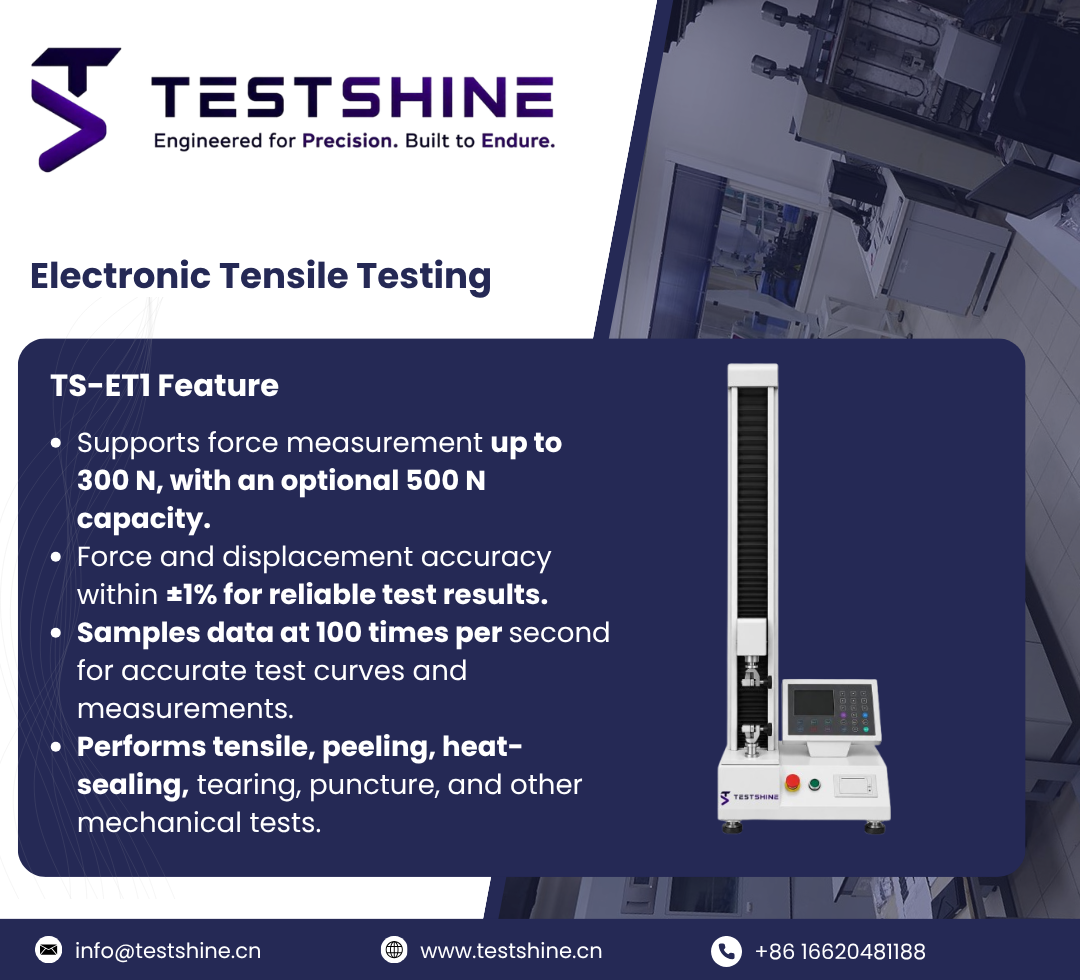
Film tensile testing, seal peel testing and laminate peel testing are often done on an electronic tensile tester fitted with suitable grips and fixtures. The Testshine TS-ET1 is a single column electronic tensile tester for packaging and material testing, used for plastic film, composite film bags, paper and medical patches.
Why it may fit your application:
- Listed test types: tension, peeling, heat sealing, tearing and puncture tests.
- Force and speed: 0 to 300 N force range (0 to 500 N optional) with indication within ±1 % of full scale (level 1), and speed of 0 to 500 mm/min, continuously adjustable, sampled 100 times per second.
- Specimen capacity: effective test width of 30 mm (50 mm customizable) and stroke of 750 mm (1000 mm customizable).
- Data and safety: LCD real time test curve, stored reports, user and permission management with audit trail, limit and overload protection, and an emergency stop.
Before you buy, confirm the load range, accuracy, grips and fixtures with Testshine for the standard methods you need to run.
References
-
ASTM International, "ASTM D882 (2026 edition), Standard Test Method for Tensile Properties of Thin Plastic Sheeting," West Conshohocken, PA, 2026. Online record: open link
-
International Organization for Standardization, "ISO 527 Part 3 (2018 edition), Plastics, Determination of tensile properties, Part 3: Test conditions for films and sheets," 2nd ed., Geneva, 2018. Online record: open link
-
ASTM International, "ASTM F88/F88M (2023 edition), Standard Test Method for Seal Strength of Flexible Barrier Materials," West Conshohocken, PA, 2023. Online record: open link
-
ASTM International, "ASTM F2029 (2016, reapproved 2021), Standard Practices for Making Laboratory Heat Seals for Determination of Heat Sealability of Flexible Barrier Materials as Measured by Seal Strength," West Conshohocken, PA, 2021. Online record: open link
-
ASTM International, "ASTM F1306 (2021, reapproved 2025), Standard Test Method for Slow Rate Penetration Resistance of Flexible Barrier Films and Laminates," West Conshohocken, PA, 2025. Online record: open link
-
ASTM International, "ASTM D1894 (2024 edition), Standard Test Method for Static and Kinetic Coefficients of Friction of Plastic Film and Sheeting," West Conshohocken, PA, 2024. Online record: open link
-
ASTM International, "ASTM D1922 (2023 edition), Standard Test Method for Propagation Tear Resistance of Plastic Film and Thin Sheeting by Pendulum Method," West Conshohocken, PA, 2023. Online record: open link
-
ASTM International, "ASTM F904 (2022 edition), Standard Practice for Separation of Plies for Bond Strength of Laminated Flexible Materials," West Conshohocken, PA, 2022. Online record: open link
-
ASTM International, "ASTM F1249 (2025 edition), Standard Test Method for Water Vapor Transmission Rate Through Plastic Film and Sheeting Using a Modulated Infrared Sensor," West Conshohocken, PA, 2025. Online record: open link
-
ASTM International, "ASTM D3985 (2024 edition), Standard Test Method for Oxygen Gas Transmission Rate Through Plastic Film and Sheeting Using a Coulometric Sensor," West Conshohocken, PA, 2024. Online record: open link
-
ASTM International, "ASTM F2338 (2024 edition), Standard Test Method for Nondestructive Detection of Leaks in Packages by Vacuum Decay Method," West Conshohocken, PA, 2024. Online record: open link
-
International Organization for Standardization, "ISO 291 (2008 edition), Plastics, Standard atmospheres for conditioning and testing," 4th ed., Geneva, 2008. Online record: open link
-
M. Merabtene, P. Tanninen, J. Varis and V. Leminen, "Heat sealing evaluation and runnability issues of flexible paper materials in a vertical form fill seal packaging machine," BioResources, vol. 17, no. 1, pages 223 to 242, 2022. Online record: open link
-
ASTM International, "ASTM E171/E171M (2011, reapproved 2020), Standard Practice for Conditioning and Testing Flexible Barrier Packaging," West Conshohocken, PA, 2020. Online record: open link
-
International Organization for Standardization, "ISO 11339 (2022 edition), Adhesives, T peel test for flexible to flexible bonded assemblies," 4th ed., Geneva, 2022. Online record: open link
Related Posts
Mechanical and Seal Integrity Testing for Flexible Packaging: A Guide to Quality Assurance
Heat Seal Strength Testing: Ensuring Reliable Seals in Flexible Packaging

Tensile Strength and Elongation Testing for Flexible Packaging Films

Coefficient of Friction Testing for Flexible Packaging: Why Surface Friction Matters
Mechanical and Seal Integrity Testing for Flexible Packaging: A Guide to Quality Assurance
Heat Seal Strength Testing: Ensuring Reliable Seals in Flexible Packaging
Tensile Strength and Elongation Testing for Flexible Packaging Films