How Strong Is Strong Enough? Measuring Material Performance with Tensile Testing

Every material has a limit. What matters is where that limit sits and whether each production batch stays above it. This issue covers the Universal Tensile Testing Machine, including how it works, what it measures, where it is used, and where the Testshine TS-UTM1 fits into a material testing programme.
Why Mechanical Testing Comes First
Picture a film that peels apart at the seal, a cap that cracks under load, a rubber part that stretches and never recovers, or a fabric that gives way at the seam. Failures like these rarely come from one dramatic mistake. More often, the material was never measured against the load it would actually carry.
Mechanical testing replaces assumption with numbers. Strength shows how much force a material can bear. Durability describes how the material behaves over time, under repeated loading or changing conditions, and it usually calls for further tests such as fatigue or ageing alongside a tensile test. Performance is the practical outcome, meaning whether the finished product does its job. Evaluating all three in the laboratory means problems are found on the bench and not in the field.

Understanding Universal Tensile Testing
What is a Universal Testing Machine?
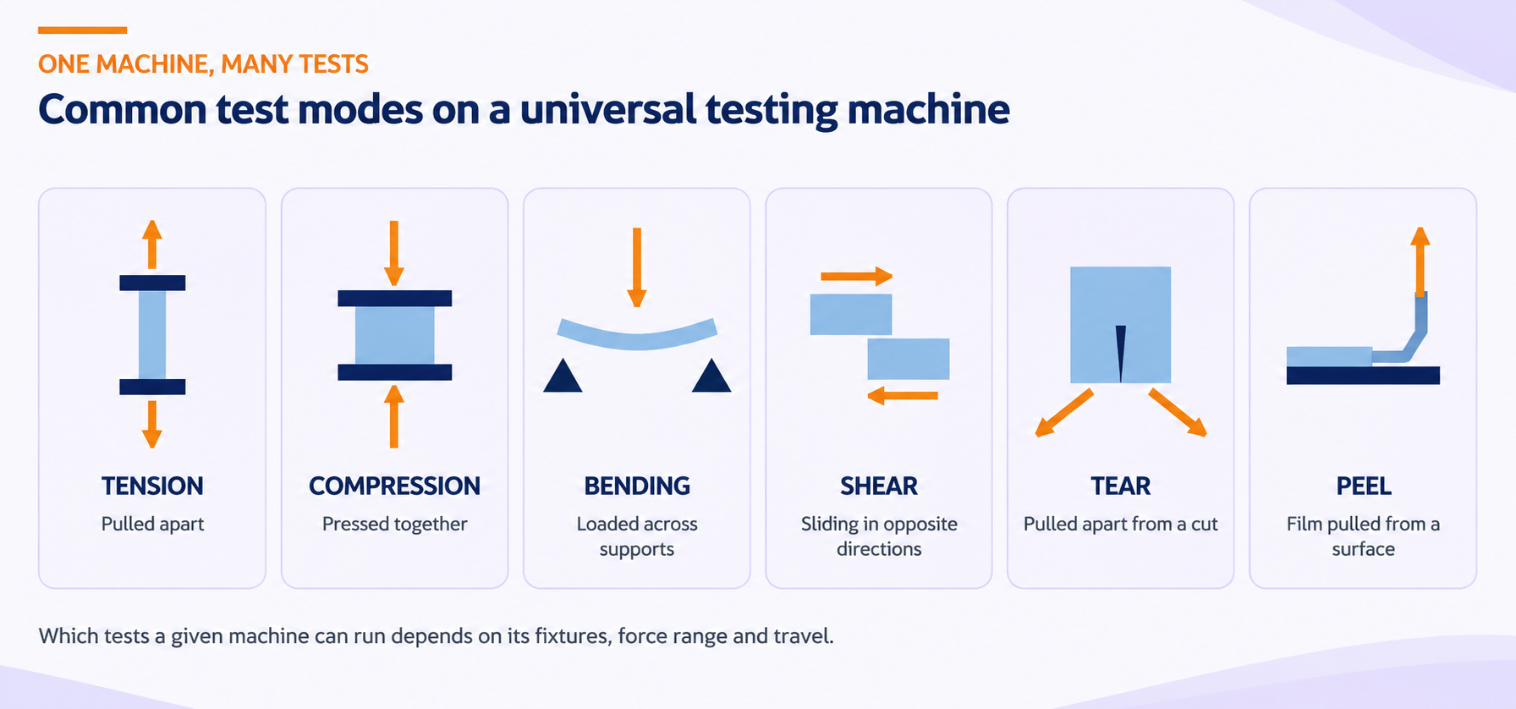
A Universal Testing Machine (UTM) applies a controlled force to a specimen and records how the specimen responds. It is called universal because one machine can run several kinds of test, including tension, compression, bending, shear, tear and peel, simply by changing the grips and fixtures. A machine used mainly to pull specimens apart is commonly called a universal tensile testing machine.
Most machines are built from the same basic parts:
- Load frame: the rigid structure that carries the test force without flexing.
- Crosshead: the moving beam that pulls or pushes at a set speed.
- Load cell: the sensor that measures the force applied to the specimen.
- Grips and fixtures: hold the specimen and define the type of test.
- Extensometer (where fitted): measures elongation directly on the specimen, which gives more accurate strain data.
- Controller and software: set the test speed, collect the data and calculate the results.
Exact configuration varies between models. The TS-UTM1 has a double column frame, an AC servo motor with a precision ball screw drive, a high precision force sensor, and a computer with test software.
How a tensile test works
The specimen is prepared to a defined shape and size and clamped between the upper and lower grips. The crosshead moves at a constant speed and stretches the specimen, while the load cell records the force and the machine records how far the specimen has extended. The test continues until the specimen breaks or reaches a preset limit.
The software then converts force and extension into stress (force divided by the original cross sectional area) and strain (change in length divided by the original length). Plotted together, these values form the stress and strain curve, which is the standard way to read the mechanical behaviour of a material.

Four results are most often taken from this curve:
- Elastic modulus: the slope of the elastic region, a measure of stiffness.
- Yield strength: the stress at which permanent deformation begins. Brittle materials may fracture without a clear yield point.
- Tensile strength: the highest stress the specimen sustains before failure.
- Elongation at break: how far the material stretches before it fails, which indicates its ductility or flexibility.
Beyond tension
With suitable fixtures, a universal machine can also perform compression, flexural (bending), shear, tear, peel and puncture tests. Which of these a particular machine can run depends on its force range, travel and available accessories, so the choice of test should always match the machine's confirmed capability.
Why Material Testing Matters
- Quality control. Test results turn a quality requirement into a pass or fail decision that can be recorded, compared and audited.
- Product reliability. Knowing the force and elongation at which a material fails shows how much margin a product has in normal use, in transport and in handling.
- Material selection. Testing candidate films, resins, rubbers or fabrics against one another replaces guesswork from datasheets when a new material is chosen or a supplier is changed.
- Manufacturing consistency. Regular testing of incoming material and finished output shows drift between batches, shifts or suppliers before it becomes a complaint.
Where Tensile Testing Is Applied
The same principle serves many industries. The table below lists common materials, what is usually checked, and examples of widely used test methods for each. These are general references to the methods themselves.
| Material | Typical evaluation | Example methods |
|---|---|---|
| Plastics | Tensile strength, yield, elongation and modulus of moulded specimens and sheet | ISO 527 Part 1, ASTM D638 |
| Packaging films | Tensile strength and elongation of thin film; strength of heat seals and peel behaviour | ASTM D882, ASTM F88 |
| Rubber and elastomers | Tensile strength, elongation at break and stress at set elongation | ISO 37, ASTM D412 |
| Textiles | Breaking force and elongation of fabric strips | ISO 13934 Part 1 |
| Paper and board | Tensile strength and stretch of paper strips | ISO 1924 Part 2 |
| Metals | Yield strength, tensile strength and ductility of metal specimens | ISO 6892 Part 1 |
The methods above describe the tests in general. For TS-UTM1, Testshine lists these test standards: ISO 527, ASTM D638 and GB/T 1040 (tensile); ISO 604 and GB/T 1041 (compression); ISO 178 and GB/T 9341 (flexural); and GB/T 13022 (plastic film tensile).
Featured Product: TS-UTM1
Testshine lists the Universal Tensile Testing Machine, model TS-UTM1, in its Packaging Testing category. The verified product details are below.
TS-UTM1 is a double column universal testing machine with a servo drive, computer control and a dual space design. It was developed for colleges, universities and research institutes. It runs tensile, compression, bending, shearing and other tests on metals, nonmetals, composite materials and finished products. It is used in industries such as building materials, aerospace, machinery, wire and cable, rubber and plastics, and textiles.
Key features
- Servo drive: an AC servo motor and a precision ball screw move the crosshead across a speed range of 0.01 to 500 mm/min.
- Many test types: tension, compression, bending, shearing, tearing and peeling. High temperature and low temperature chambers and furnaces can be added.
- Test software: results are saved automatically, curves can be replayed, compared and magnified, and reports are printed in real time.
- Automatic results: tensile strength, yield strength, elastic modulus, elongation, flexural modulus and more are calculated after each test.
- Safety features: overload emergency shutdown, upper and lower travel limits, automatic power off on leakage, and automatic shutdown at the breakpoint.
Technical specifications
| Parameter | Specification |
|---|---|
| Load capacity | 20 kN |
| Force measurement accuracy | ≤ 0.5% |
| Test speed range | 0.01 to 500 mm/min |
| Crosshead travel / test space | Test stroke 600 mm (excluding gripper); test width 400 mm |
| Grips and fixtures supplied | One set of test fixtures |
| Test types supported | Tension, compression, bending, shearing, tearing and peeling |
| Applicable standards | ISO 527, ISO 178, ISO 604, ASTM D638, GB/T 1040, GB/T 1041, GB/T 9341, GB/T 13022 |
| Software and data output | Windows based test software; reports exported as Excel, PDF or Word |
| Power supply | 220 V, 50 Hz; about 1000 W |
| Machine size and weight | About 500 × 500 × 1500 mm (L × W × H); about 250 kg |
Why Choose Testshine?
Testshine supplies testing instruments for material and product evaluation, and TS-UTM1 belongs to its Packaging Testing range. We believe a testing instrument should be easy to understand before it is bought, so our product information aims to state clearly what a machine is, which category it belongs to, and what its confirmed specifications are.
If you are choosing a tensile tester, the most useful first step is a conversation about your own samples: the materials, the specimen sizes, the forces involved and the standards your customers expect. With that information you can judge whether any machine, including TS-UTM1, is the right fit, and our team is happy to go through it with you.
Test the Material. Then Trust the Result.
A tensile curve is a short record of how a material behaves under load, and few measurements say more about quality in so little time. Whether you are checking incoming film, qualifying a new resin or investigating a batch that behaved differently, consistent testing gives you evidence to act on instead of opinions to argue over.
We invite you to explore Testshine testing solutions and to tell us which materials and tests matter to your operation. Share what you need to measure, and we will help you work out how to measure it.
Related Reading from the Testshine Lab
Paper and plastics both appear in the table earlier in this issue. Two articles on the Testshine website look at quality control testing for each in more depth.
- Quality Control and Testing of Paper (Click Here)
A guide to quality control in paper making, from raw material checks and in process monitoring to finished paper testing, laboratory instruments and ISO, TAPPI and ASTM standards. - Recycling Plastics: Quality Control Tests and Essential Laboratory Equipment (Click Here)
An overview of the quality control tests and laboratory equipment used to evaluate recycled plastics, from melt flow to mechanical and thermal testing.
Contact information
- Website: testshine.cn
- Email: info@testshine.cn
- Contact page: testshine.cn/contact
- Phone / WhatsApp: +86 16620481188
- LinkedIn: linkedin.com/company/testshine-co-ltd
Related Updates